Underage Consumption: What a Headache.
Posted by Arrin Zadeh in criminal offense, Criminal Record, Frequently Asked Questions, Legal Rights on March 7th, 2024
As most folks should know, if you are under the age of 21 you are not allowed to consume alcohol in Tennessee (and all other states in the U.S.). In fact, an underage person who has been drinking or is in possession of alcohol could find themselves in trouble not only criminally, but also academically. The days of college kids getting a “slap on the wrist” for underage consumption are gone. Getting caught underage drinking, at a bar or elsewhere, and being asked to leave/safely get home is no longer the norm. More and more underage individuals are being arrested for drinking underage and the consequences are much more serious than just a headache from a bit too much to drink.
Under Tennessee law, an offense of Underage Consumption is codified in T.C.A. § 1-3-113. The code sets out that if one is underage (under 21 years of age) and that person is arrested or cited for drinking/possessing alcohol (among several things), the punishment can be up to 11 months and 29 days in jail, if convicted. This means the offense of Underage Consumption is a Class A Misdemeanor, the most serious class of Misdemeanor Offense in Tennessee. Additionally, the individual faces up to a $2,500 dollar fine. In some cases, the person could lose their driving privileges up to one year.
Aside from the legal punishments, if the individual is in school (high school or college) and charged with Underage Consumption of Alcohol, they can also face academic consequences (such as: probation, loss of scholarship, or expulsion). Depending on the circumstances, the individual’s academic record could be tainted and could lead to difficulties graduating or being accepted into a competitive graduate school program.
As the reader can tell, drinking underage can lead to more than just a headache from the hangover. This offense can lead to major difficulties for that individuals’ future (criminally and academically).
A knowledgeable and well-versed lawyer may be able to help not only avoid a conviction for this offense but be able to erase it from the individual’s public criminal history. The lawyers at Oberman and Rice are willing and able to help with such a situation. The Oberman and Rice Law Firm is located only a few minutes from the University of Tennessee-Knoxville and deals with many of these types of alcohol violations (and academic situations). Our lawyers are available 24 hours a day if you or a loved one needs help and/or information to preserve their future because of an underage drinking charge. The Oberman and Rice Law Firm may be reached by calling (865) 249-7200.
Need More Information?
Posted by Sara Compher-Rice in Uncategorized on February 13th, 2024
Due to the overwhelming demand for answers to your DUI questions, we have added additional information to our main website, https://www.tndui.com/. Feel free to check it out. We will also be monitoring this site as well. Typically, we will respond on this site only to questions of general interest.
If you would like to hire one of our lawyers to assist you with your particular issue, you may call us at (865) 249-7200 during regular business hours or email us at PleaseHelp@tndui.com with:
- Your question;
- The Tennessee county involved (remember, we are only licensed in Tennessee); and
- Your contact information
We will then contact you the following business day.
New DUI Law Alert–Work Release Requirement Update
Posted by Sara Compher-Rice in Court Procedures, criminal offense, DUI Penalties, Frequently Asked Questions, Tennessee DUI Laws, Tennessee DUI News on January 8th, 2024
The Tennessee Legislature passed several new laws that are scheduled to take effect on January 1, 2024. The second DUI related law we are highlighting involves the Tennessee Work Release Program. Work release is a form of probation that may be used, in certain circumstances, after a person has served their mandatory minimum sentence. In fact, many DUI offenders are precluded from work release programs, which allow offenders to leave the detention facility at scheduled times to attend work. Beginning January 1, 2024, Tennessee criminal offenders who are accepted into a work release program have additional restrictions.
Under this new law, “beginning January 1, 2024, a prisoner of a county workhouse or jail who is released from custody on work release or otherwise allowed to leave the grounds of the county workhouse or jail for employment or to perform work in the community, whether the work is paid or unpaid, must use an electronic monitoring device at all times when the prisoner is not on the grounds of the county workhouse or jail.” Tennessee Code Annotated § 41-2-152. Additionally, the entity employing the offender is responsible for all costs associated with the electronic monitoring device.
Should you have any questions relating to a DUI arrest in Tennessee or about the requirements under Tennessee DUI laws, the lawyers at Oberman & Rice are available to speak with you at (865) 249-7200. You may learn more about Tennessee Driving Under the Influence laws by visiting www.tndui.com.
New DUI Law Alert–Ignition Interlock Device Update
Posted by Sara Compher-Rice in Frequently Asked Questions, Ignition Interlock Device, Tennessee Driver's License, Tennessee DUI Consequences, Tennessee DUI Information, Tennessee DUI Laws, Tennessee DUI News on January 1st, 2024
The Tennessee Legislature passed several new laws that are scheduled to take effect on January 1, 2024. Very few of the new Tennessee laws impact those accused of driving under the influence (DUI). The next two blog posts will highlight these new DUI related laws.
Beginning 1/1/24, all Ignition Interlock Devices (IIDs) must employ GPS technology that will geotag the vehicle’s location when the following occurs:
- The driver performs the initial startup test on the IID
- The driver is required to randomly retest
- The driver skips a test required by the ignition interlock device
- A circumvention of the ignition interlock device is detected
The law does require, however, that the GPS not continuously track the location of the vehicle.
Should you have any questions relating to a DUI arrest in Tennessee or about the requirements under Tennessee DUI laws, the lawyers at Oberman & Rice are available to speak with you at (865) 249-7200. You may learn more about Tennessee Driving Under the Influence laws by visiting www.tndui.com.
New Year’s Eve Traffic Enforcement and Sobriety Checkpoints
Posted by Sara Compher-Rice in Tennessee DUI Checkpoints, Tennessee DUI Information, Tennessee DUI News, Tennessee Traffic Violations, THP, Traffic Citations on December 28th, 2023
As 2023 draws to a close, the Tennessee Highway Patrol has planned several Sobriety Checkpoints (also commonly referred to as a “DUI Roadblocks”) in East Tennessee. Motorists in Monroe County can expect a DUI Roadblock on December 29, 2023 on U.S. 411 at the Monroe/Loudon County line. THP has also planned a Knox County Sobriety Checkpoint on New Year’s Eve at Cherokee Trail and Cherokee Bluff Drive. A full list of the Tennessee Highway Patrol checkpoint enforcement dates and locations can be found by clicking here.
The DUI defense lawyers at the Oberman & Rice Law Firm are always available to assist those arrested or cited for a traffic violation. If you or a loved one find yourself in need of a criminal defense or traffic lawyer, please make sure to contact one of our law partners at (865) 249-7200 or by visiting www.tndui.com. Even though most law firms are closed during this holiday period, all of our lawyers will be available 24/7 to help you and take your call. If we cannot be of assistance, then our firm will attempt to help find you someone who can. Oberman & Rice wishes you all a safe and healthy New Year.
Exercise Caution New Years Eve 2021!
Posted by Steve Oberman in Tennessee DUI Checkpoints, Tennessee DUI Information, Tennessee DUI News on December 31st, 2021
Beginning at 6:00 PM on Friday, New Year’s Eve all the way through Sunday, January 2, 2022 at 11:59 PM, Tennessee Highway Patrol Officers will be performing traffic saturation patrols and to ensure drivers are wearing seatbelts, have a valid driver’s licenses and are sober. The Oberman and Rice lawyers recommend getting a ride or having a designated driver. Don’t start your New Year in jail!
What Is An Ignition Interlock Device?
Posted by Sara Compher-Rice in Frequently Asked Questions, Ignition Interlock Device, Tennessee Driver's License on December 30th, 2020
Tennessee law requires the use of an Ignition Interlock Device (“IID”) for most motorists upon conviction of Driving Under the Influence (“DUI”). The requirement of an IID generates many questions for TN motorists. Primary among the questions is: What is an Ignition Interlock Device?
Tennessee Department of Safety and Homeland Security High Patrol Division Rule 1340-03-06-.02 defines an Ignition Interlock Device as “a device that is designed to allow a driver to start a vehicle if the driver’s [Breath Alcohol Concentration (“BrAC”)] is below the set point and to prevent the driver from starting the vehicle if the driver’s BrAC is at or above the set point.”
An IID is essentially a breath alcohol test device that requires a driver to register a breath test sample not only prior to starting the vehicle, but also periodically while operating the vehicle, to verify that the driver’s breath alcohol concentration remains below a preset level. Tennessee law requires Ignition Interlock Devices be calibrated to a setting of .02%. Accordingly, should the driver register at or above .02%, the IID will prevent the vehicle from being started.
In the coming weeks, this blog will address additional questions surrounding the Tennessee IID requirements, including, but not limited to: When is an IID required? Is an IID mandated even when a DUI conviction does not involve alcohol? What procedures must be met to have an IID removed from a motorists’ vehicle? What are the consequences an Ignition Interlock Device violation?
In the meantime, should you have any questions relating to a Tennessee DUI arrest, the lawyers at Oberman & Rice are available to speak with you at (865) 249-7200.
TDOS Offers New Online Features for License Reinstatement
Posted by Sara Compher-Rice in Driver License Reinstatement, Frequently Asked Questions, Tennessee Driver's License, Tennessee DUI News on December 3rd, 2020
On December 2, 2020, the Tennessee Department of Safety (TDOS) announced new online services available for those with suspended or revoked driver licenses. Although not available for all drivers, many can now complete the entire reinstatement process without visiting a Driver Service Center in person. In addition to the online option, TDOS also offers the use of self-service kiosks and iPads at Driver Service Centers. However, TDOS notes that not all drivers are eligible to use online, self-service kiosk, or iPad for driver license reissuance. If you are not able to complete the reinstatement process online, you will be required to visit a Reinstatement Center.
One component of reinstating a driver license using online is the submission of the required compliance documents. The required documentation is dependent upon the cause of the license revocation (e.g., Driving Under the Influence, Implied Consent Violation, Failure to Satisfy a Traffic Citation, Failure to Show Proof of Financial Responsibility, etc.). A list of the violations that trigger license revocation and the corresponding reinstatement requirements can be found here: https://www.tn.gov/safety/driver-services/reinstatements.html#Compliance. Likewise, a list and description of the compliance documents can be found here: https://www.tn.gov/safety/driver-services/reinstatements.html#Compliance.
Detailed information about how to pay reinstatement fees and how to submit the required compliance documents can be found by visiting: https://www.tn.gov/safety/driver-services/reinstatements.html#Compliance. A review of our prior blog post, TN Driver License Reinstatement—Navigating the TDOS Website, may be helpful when accessing the online services.
Should you or a loved one need legal assistance with your Tennessee Driver’s License or the Reinstatement process, our attorneys at the Oberman & Rice Law Firm are available to assist you and may be reached by calling (865) 249-7200.
TN Driver License Reinstatement—Navigating the TDOS Website
Posted by Sara Compher-Rice in Driver License Reinstatement, Frequently Asked Questions, Tennessee Driver's License, Uncategorized on November 20th, 2020
Are you unsure of the status of your Tennessee Driver’s License? Is your license eligible for reinstatement but you don’t know where to begin? The Tennessee Department of Safety website is actually a valuable tool to help get these answers–and more!
You can log in to the Tennessee Department of Safety E-Services to access information relating to your driver’s license at https://dl.safety.tn.gov/_/.

Once you log in, you can access a variety of online services, including a list of reinstatement requirements and the ability to pay reinstatement fees.
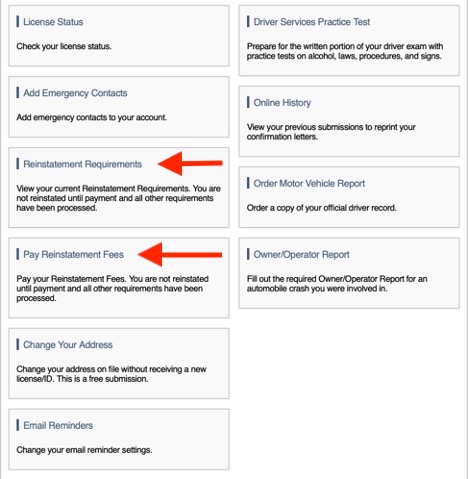
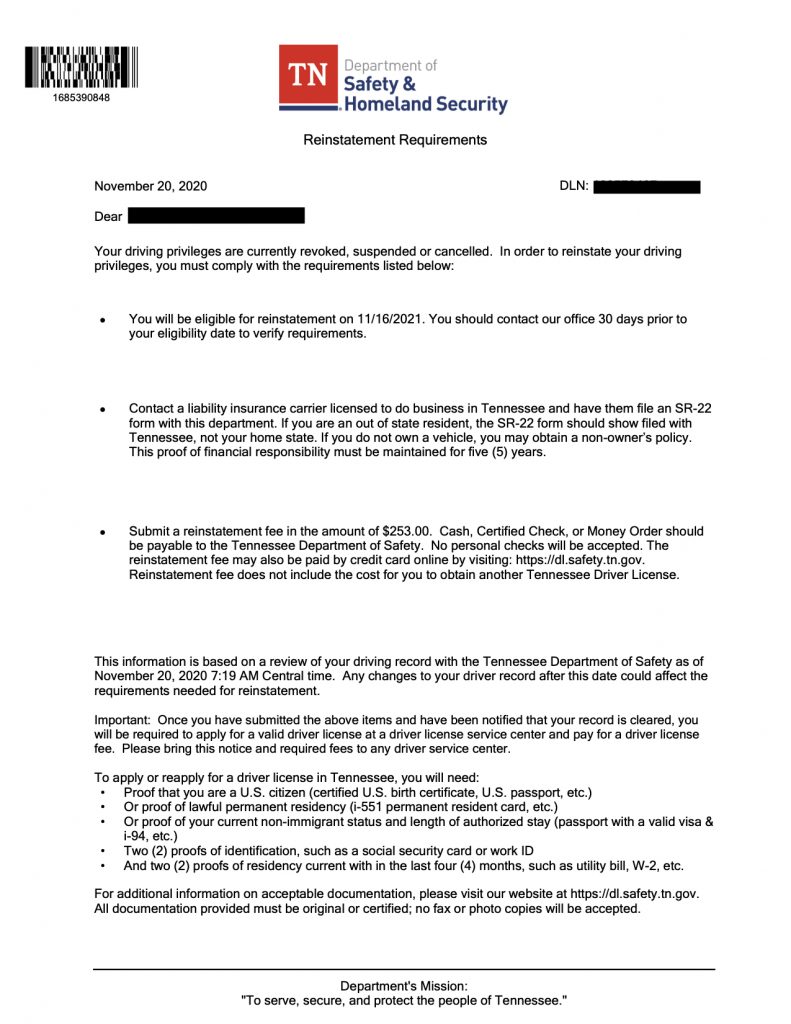
You can click on “Reinstatement Requirements” to access a document that outlines the exact steps needed to reinstate your Tennessee Driver’s License. An example of this document is included below:
If you need legal assistance with your Tennessee Driver’s License, you may contact one of the attorneys at Oberman & Rice by calling (865) 249-7200.
Consequences of a TN DUI Conviction – Part 3
Posted by Sara Compher-Rice in Podcasts on July 27th, 2020
In this week’s podcast, host and Knoxville DUI attorney Steve Oberman presents Part 3 of a podcast series explaining some of the Collateral Consequences that result from a Tennessee DUI conviction. The purpose of this series is to summarize some, but certainly not all, of the lesser known consequences one faces if convicted of DUI. This episode focuses on the potential effects of a Tennessee Driving Under the Influence (DUI) in Tennessee on professional licenses and a person’s internet profile.
Our Knoxville, TN DUI lawyers are also happy to answer any questions you may have about these and other issues surrounding a Tennessee DUI charge and the resulting penalties. Feel free to call our office at (865) 249-7200.
Audio clip: Adobe Flash Player (version 9 or above) is required to play this audio clip. Download the latest version here. You also need to have JavaScript enabled in your browser.
Additional information about the Collateral Consequences of a Tennessee DUI conviction, as well as the Tennessee DUI penalties mandated by law can be found by visiting the website of Knoxville DUI attorneys, Oberman & Rice, at www.tndui.com and www.duiknoxville.com. Part 1 of this series, Collateral Consequences of a TN DUI Conviction – Part 1, can also be heard by clicking here. Part 2 of this series, Collateral Consequences of a TN DUI Conviction – Part 2, can also be heard by clicking here.
You can also watch a video version of this podcast on YouTube.
Podcast: Play in new window | Download
Expungements in TN- What You Need to Know
Posted by Sara Compher-Rice in Podcasts on July 6th, 2020
In this week’s podcast, host and Knoxville DUI attorney Steve Oberman provides a summary of Expungement laws in Tennessee. While this podcast provides an overview of the Tennessee Expungement laws, Steve, Sara, and AZ are happy to address any questions you have and can be reached by calling (865) 249-7200. You can also find a video version of this podcast on YouTube.
Audio clip: Adobe Flash Player (version 9 or above) is required to play this audio clip. Download the latest version here. You also need to have JavaScript enabled in your browser.
Copyright © The Oberman & Rice Law Firm
Oberman & Rice
550 Main St., Ste. 730
Knoxville, TN 37902
(865) 249-7200
www.tncriminaldefense.com
www.eraseyourrecord.com
Podcast: Play in new window | Download
Happy Holidays from the Tennessee Highway Patrol- Sobriety Checkpoints
Posted by Arrin Zadeh in DUI Penalties, Tennessee DUI Checkpoints, Tennessee DUI Information, Tennessee DUI News on December 20th, 2019
Motorists venturing to Grandmother’s house this holiday season in East Tennessee need to be very careful and prepared for delays while passing through several checkpoints throughout the end of the year and leading into the new year. Tennessee Highway Patrol and other law enforcement agencies will be out in full force over the next few weeks to ensure that drivers heading to see family and friends are not operating their vehicle while impaired or committing traffic violations.
The 2019 Christmas/New Year holiday enforcement period has already started and will include several sobriety checkpoints in the following East Tennessee counties: Knox, Union, Campbell, Monroe, Morgan and Scott. For a full list of checkpoints please click here.
The DUI defense lawyers at Oberman & Rice are always willing to help those who may find themselves being arrested at one of these checkpoints or being cited for a traffic violation. If you or a loved one find yourself in need of a skilled trial lawyer, please make sure to contact one of our three law partners at (865) 249-7200 or by visiting www.tndui.com. Even though most law firms are closed during this holiday period, all of our lawyers will be available 24/7 to help you with any situation you may find yourself. If we cannot be of assistance, then our firm will attempt to help find you someone who can.
Drivers Rejoice – Speed Limit Increase On I-40/I-640 in Knoxville
Posted by Arrin Zadeh in Tennessee Traffic Violations on October 28th, 2019
Motorists driving through Knoxville on I-40 and I-640 splits should be on notice that the speed limits have been modified by the Tennessee Department of Safety (TDOT). According to a recent WVLT article, TDOT has increased the marked speed limits on I-40/I-640 splits. As Mark Nagi said, “I don’t like to make predictions, but I wouldn’t think [speed limits would be raised again] because there is so much congestion in the areas where we haven’t increased the speed limit to 70.” Most of the changes to the speed limits will be from 55 miles per hour (m.p.h.) to 65 m.p.h.
In 2004, the speed limits were reduced to make Knoxville fall into compliance with National Ambient Air Quality Standards. Since that time, Knoxville has reduced their omissions and are now in compliance. The changes in speed limits are at the following locations:
- I-40 from Mile Marker 367.8-385.2 (65 m.p.h. throughout);
- I-40 from Mile Marker 385.2-390.2 (60 m.p.h. throughout);
- I-40 from Mile Marker 395.7-409.7 (70 m.p.h. throughout);
- I-640 from Mile Marker 0.0-3.6 (65 m.p.h. throughout);
- I-640 from Mile Marker 3.6-10.6 (65 m.p.h. throughout).
Aside from being aware of the speed limit changes in Knoxville, drivers should also be aware that many arrests stem from a simple speeding ticket (or any traffic citation for that matter). Many misdemeanor and felony charges arise from the simple act of driving over or under the speed limit. Such criminal charges can include Driving Under the Influence; Misdemeanor Drug possession and Felony Drug possession along with many other potential charges. If you find yourself being charged with a simple traffic violation or any criminal offense, you need a knowledgeable lawyer willing to answer all of your questions. Please contact the lawyers at the Oberman & Rice Law Firm by phone at (865) 249-7200 or via email at our website if you find yourself in need of legal assistance.
Speeding or Traffic Ticket? Talk to a Lawyer!
Posted by Arrin Zadeh in criminal offense, Criminal Record, Tennessee Driver's License, Traffic Citations, Traffic Ticket, Uncategorized on October 1st, 2019
No matter where you are driving in the United States, one constant exists: Drive over the Speed Limit and you are probably going to receive a ticket. These tickets that are administered by various law enforcement agencies are meant to levy punishments against the driver as a form of deterrence. These punishments normally include: fines/court costs; potential points/infractions on one’s driving record; required attendance to a driving school and a potential increase in insurance premiums. Public safety is the main reason for deterrence, and these Speeding tickets (along with other traffic citations) serve as a way to help prevent accidents and keep folks safe on the roadways.
Frequently, however, individuals who receive Speeding tickets (and other traffic citations) choose not to get a lawyer and instead handle the case on their own (or pro se.) While there is nothing legally (or ethically) wrong with the handling of a traffic ticket oneself, a lawyer should know the procedures and local rules of a jurisdiction where the ticket may be docketed (and potentially help obtain a favorable outcome). Additionally, a lawyer should be able to advise the driver about any potential point increase on their driving record and other risks associated with just “paying off a ticket.” “Paying off a ticket” is equal to being found guilty of the alleged traffic infraction.
Commercial Drivers (those having Commercial Driver’s Licenses or C.D.L.) also need to be extremely careful as states (such as Tennessee) are cracking down on these special license holders. C.D.L. drivers should always consult with a lawyer before handling any Speeding ticket or traffic citation because such offenses could potentially lead to disastrous consequences for the C.D.L. holder.
If you receive a Speeding ticket or any other traffic citation please contact a knowledgeable lawyer to help advise you on the situation. Furthermore, if you receive a Speeding ticket or traffic citation in Tennessee please feel free to contact the lawyers of Oberman & Rice. With over 80 years combined experience, the law partners of Oberman & Rice are ready to answer your questions about any ramifications a Speeding ticket may have on your driving record. Our lawyers may be contacted by calling (865) 249-7200 or by email at and of the following: az@tndui.com, sara@tndui.com or oberman@tndui.com.
Labor Day Weekend 2019: Sobriety Checkpoints Planned for East Tennessee
Posted by Arrin Zadeh in Boating Under the Influence (BUI), DUI Penalties, Field Sobriety Tests, Hiring a Tennessee DUI Attorney, Legal Rights, Tennessee DUI Checkpoints, Tennessee DUI Consequences, Tennessee DUI Information, Tennessee DUI Laws, Tennessee DUI News, Traffic Citations, Traffic Ticket on August 28th, 2019
Drivers in East Tennessee need to be mindful during the upcoming Labor Day Weekend while driving to the lake for one more weekend of “fun in the sun” before the summer ends and football time begins! Tennessee Highway Patrol troopers and other law enforcement agencies will be out in force in most of the East Tennessee area this Labor Day weekend ensuring that motorists are not driving while impaired or committing traffic violations.
The 2019 holiday enforcement period begins Friday, August 30, and will include several sobriety checkpoints in the following East Tennessee counties: Union, Campbell, Monroe and Sevier. For a full list of checkpoints please click here.
The DUI defense lawyers at Oberman & Rice are always willing to help those who may find themselves being arrested at one of these checkpoints or being cited for a traffic violation. If you or a loved one find yourself in need of a skilled trial lawyer, please make sure to contact one of our three law partners 24/7 at (865) 249-7200 or by visiting www.tndui.com.
New Tool to Aid Law Enforcement in D.U.I. Enforcement
Posted by Arrin Zadeh in Breath on August 7th, 2019
Many road warriors across the country know that if you drink too much alcohol and operate a motor vehicle on a public roadway you may be arrested for Driving Under the Influence (D.U.I.). A lot of drivers are not aware that a D.U.I. charge may also arise out of the use of prescription medication and/or the use of marijuana (even if legal in your state to consume). The issue for law enforcement, however, is how to test for medications and marijuana traces from the person suspected of committing a D.U.I. based on the consumption of drugs alone and not alcohol (while not obtaining a blood sample). Law enforcement agencies have long implemented the use of a portable breath test device to detect the presence of alcohol on a suspect, but now- a new tool has been adopted by law enforcement agencies to combat drivers who are suspected to be impaired by drugs.
According to a recent U.S.A. Today article, the new tool for law enforcement agencies is a portable “lab” that can test the oral fluids of the alleged D.U.I. offender through a simple swab of the suspect’s mouth for saliva. The device is called the Dräger DrugTest® 5000. The device is supposed to determine if the driver has any traces (in their saliva) of drugs including, but not limited to: amphetamines, opiates, cocaine, and cannabinoids. As of the publishing of the U.S.A. Today article, law enforcement agencies in several cities have already implemented the device in the field.
Presumably, the use and science behind this new tool for law enforcement will be challenged in a court of law (much like the alcohol portable breath test device has been for years). Please remember if you or someone you know has been charged with a D.U.I. alleging alcohol or drug impairment, make sure to call and speak with one of our attorneys at the Oberman and Rice Law Firm. The Obermand and Rice Law Firm can be reached 24/7 at (865) 249-7200 or by email at oberman@tndui.com, sara@tndui.com or az@tndui.com.
Don’t Drink and Scoot
Posted by Arrin Zadeh in Boating Under the Influence (BUI), DUI First Offense Penalties, DUI Penalties, Hiring a Tennessee DUI Attorney, Legal Rights, Tennessee Driver's License, Tennessee DUI Consequences, Tennessee DUI Information, Tennessee DUI Laws, Tennessee DUI News, Tennessee DUI Penalties, Tennessee Traffic Violations, TN BUI on July 3rd, 2019
On July 1, 2019, several new laws and modifications of current Tennessee DUI laws were implemented. The first we will discuss (with more updates to follow on this blog) refers to all of the scooters that have become common place in most major downtown areas in Tennessee. In downtown Knoxville, for example, you cannot walk a block without seeing these scooters available for rent. In case you are not familiar with these scooters, one such company, called Zagster (2024 update: Zagster has since closed. If you are interested, in what happened to Zagster, read this article by Randy Joycelyn), releases these scooters for rent and places many of them around busy areas hoping for people passing by to rent one to travel (or scoot) around the city. It is hard pressed to not see at least one person zooming along the street or sidewalk on one of these devices.
The new law, mentioned above, aims to eliminate the problem of impaired people renting these scooters by making such an action punishable under Tennessee’s DUI laws. As this recent article on WKRN states, these electric scooters will be considered motor-driven vehicles. This language is important because under Tennessee’s DUI laws, the operator must be in physical control of a motor-driven vehicle to be arrested for a DUI. As we have discussed previously on this blog (and at our website- www.tndui.com), if convicted of a DUI you face some of the following punishments: mandatory jail time (up to 48 hours on a First Offense); fines; required attendance of a Drug Education Course and a loss of your Tennessee driving privilege.
Please remember that over this holiday weekend if you decide to enjoy the festivities in an area that allows for these scooters to be rented, please do not drink and scoot. You may find yourself being placed under arrest for a DUI! If you’ve been charged with Driving Under the Influence in Tennessee while on one of these scooters, operating a boat or while driving in your vehicle, please contact the Oberman and Rice Law Firm at (865) 249-7200. We are available 24/7.
THP set to combat distracted drivers with “Operation Incognito”
Posted by Arrin Zadeh in Court Procedures, criminal offense, Driver License Reinstatement, Frequently Asked Questions, Legal Rights, Tennessee Driver's License, THP, Traffic Citations, Traffic Ticket, Uncategorized on November 13th, 2018
Drivers on the roads throughout Tennessee who are preparing for the Holiday Season need to be mindful as the Tennessee Highway Patrol initiates “Operation Incognito”. The campaign started on November 11 and plans to run through November 17.
The initiative’s goal is to combat distracted driving (texting while driving, etc.) on the roads of Tennessee. As THSO Director Vic Donoho states, “The primary focus of Operation Incognito is to reduce distracted driving, serious injury traffic crashes, and fatalities.” Additionally, THSO Director Vic Donoho goes on to say that some secondary goals of “Operation Incognito” will be for the Tennessee Highway Patrol to saturate construction zones and attempt to increase driver’s awareness for utility maintenance zones.
The DUI defense lawyers at Oberman & Rice are always willing to help those who may receive any traffic citations during the Operation Incognito campaign and beyond. Traffic violations (if convicted) can add points to your driver’s license and cause your insurance premiums to skyrocket. Before you pay off a traffic citation and receive a conviction, it is important to discuss with a lawyer any potential penalties and consequences. Please review our website for more information or call us with questions at (865) 249-7200. Our lawyers are available 24/7.
Tennessee Highway Patrol Planned Checkpoint For Labor Day 2018
Posted by Arrin Zadeh in Boating Under the Influence (BUI), Breath, Chemical (Blood, criminal offense, DUI Penalties, Field Sobriety Tests, Frequently Asked Questions, Horizontal Gaze Nystagmus Test, Legal Rights, One Leg Stand Test, Tennessee DUI Checkpoints, Tennessee DUI Chemical Tests, Tennessee DUI Consequences, Tennessee DUI Information, Tennessee DUI Laws, Tennessee DUI News, Tennessee DUI Penalties, Tennessee Traffic Violations, Walk and Turn Test on August 27th, 2018
Motorists in Knoxville need to be mindful during the upcoming Labor Day Weekend while driving to the lake or local pools to celebrate the “unofficial” end of summer. Tennessee Highway Patrol troopers will be out in force this Labor Day weekend ensuring that motorists are not driving while impaired or committing traffic violations.
The 2018 holiday enforcement period begins Saturday, September 1, and will include a sobriety checkpoint at East Emory Road at Longmire in Knox County, Tennessee. Other checkpoints are scheduled throughout September for the East Tennessee area. For a list of all planed checkpoints in September please click here.
The DUI defense lawyers at Oberman & Rice are always willing to help those who may be falsely accused, but we’d prefer that the readers of this blog not place themselves in a position to be suspected of driving under the influence of an intoxicant. Please review our website for more information or call us with questions at (865) 249-7200.
Fourth of July Holiday and Fireworks
Posted by Arrin Zadeh in criminal offense, Criminal Record, Frequently Asked Questions, Legal Rights on June 28th, 2018
With the Fourth of July Holiday quickly approaching, it is important to take a step back from the lake adventures and cookouts to think of our great country and how many of our forefathers fought and persevered for our country’s Independence around 242 years ago. As with every Fourth of July Holiday, the city of Knoxville will have a celebration (rain or shine) that culminates with Fireworks (free to the public) starting around 4:00 p.m. and the Fireworks to be deployed around 9:45 p.m. Information regarding the celebration may be found here.
All of us love fireworks (except for maybe our four-legged family members). Please remember that the City of Knoxville prohibits the possession, transportation, storage, manufacture, sale, handling and discharge of fireworks without a permit from the Fire Marshall (See the Knoxville Tennessee City Code of Ordinances, Section 11-5 through 11-7). Furthermore, violation of this City Ordinance is a Misdemeanor with a fine of up to $500.00 and/or 30 days in jail for each separate offense (See the Knoxville Tennessee City Code of Ordinances, Section 1-9; General penalty- continuing violations). In other words, shooting (even simply handling) fireworks without a permit in the City of Knoxville can lead to criminal prosecution that may result in a criminal conviction on your criminal public record that may hinder your ability to obtain a job or your ability to receive a scholarship for college/higher education. Additionally, Knox County (outside the city limits of Knoxville) does not allow the shooting/possession of fireworks.
The criminal defense lawyers at Oberman & Rice are always willing to help those who have been arrest or cited for a criminal offense. Our lawyers are available 24/7 to answer questions regarding an arrest or citation for any criminal offense. Please review our website for more information or call us with questions at (865) 249-7200.
Restoration of Driving Privileges For HMVO Offenders
Posted by Sara Compher-Rice in Habitual Motor Vehicle Offender (HMVO), Tennessee HMVO on June 4th, 2018
Three years from the date of a final order declaring a person an Habitual Motor Vehicle Offender, the person may file at petition seeking restoration of his or her driving privileges. The petition may be filed with the court who entered the HMVO order or any criminal court in the person’s county of residence. Although the law indicates a mandatory minimum 3-year period for the driver’s license revocation of an HMVO offender, upon the expiration of the 3 years, the offender is not permitted to drive in Tennessee. The Habitual Motor Vehicle Offender must first obtain permission from a court and take the necessary steps thereafter to have his or her license reinstated by the Tennessee Department of Safety.
The court may, in its discretion, restore the person’s driving privilege and may also require. The court may also order terms and conditions relating to the issuance of the habitual offender’s driver’s license. The habitual offender is further required to meet all requirements of the Tennessee financial responsibility (insurance) law.
Although the law indicates a mandatory minimum 3-year period for the driver’s license revocation of an HMVO offender, upon the expiration of the 3 years, the offender is not permitted to drive in Tennessee. The Habitual Motor Vehicle Offender must first obtain permission from a court and take the necessary steps thereafter to have his or her license reinstated by the Tennessee Department of Safety. If the persons drives before completing the appropriate procedures, the HMVO offender may be subjected to criminal penalties.
If you have immediate questions about the Tennessee HMVO law, please feel free to the Oberman and Rice Law Firm at (865) 249-7200.
Tennessee HMVO Violation Penalties
Posted by Sara Compher-Rice in Habitual Motor Vehicle Offender (HMVO), Tennessee HMVO on June 1st, 2018
Once a person is declared an Habitual Motor Vehicle Offender, the penalties for driving are quite severe. The person is prohibited from driving in Tennessee while the HMVO judgment or order prohibiting driving is in effect. If found operating a motor vehicle, the HMVO offender commits a Class E felony. No traffic or criminal violation is required for an HMVO violation–the only requirement is that the person be found to be operating a motor vehicle in Tennessee.
If convicted of the felony offense of Habitual Motor Vehicle Offender, the person may be sentenced to serve one to six years imprisonment and be subjected to a fine not exceeding $3,000.00.
If you have any questions about the Tennessee HMVO law or other Tennessee criminal offenses, please contact the Oberman and Rice Law Firm at (865) 249-7200.
How To Be Declared a TN Habitual Motor Vehicle Offender
Posted by Sara Compher-Rice in Habitual Motor Vehicle Offender (HMVO), Tennessee HMVO on May 28th, 2018
The Tennessee Department of Safety is tasked with keeping records of convictions of the HMVO qualifying offenses. Once the records reveal that an individual has accumulated the appropriate number of convictions (3 within 5 years or 5 within 10 years), the commissioner of the Tennessee Department of Safety shall furnish this record to the district attorney’s office in the district where the individual either resides or may be found.
Once the district attorney’s office receives the record, they have a duty to file a petition against the individual in the court of general criminal jurisdiction. However, a record from the TDOS is not required before a petition may be filed. After the petition is filed, the court must issue an Order directing the individual (defendant) named in the petition to appear in court to show cause why the person should not be barred from operating a motor vehicle in Tennessee.
If, following the proper procedures and findings, the court finds that the defendant is an habitual offender, the court shall then issue an order prohibiting the defendant from operating a moron vehicle in Tennessee. The defendant is further required to surrender his or her driver’s license once declared an Habitual Motor Vehicle Offender. The defendant is prohibited from driving under a court restores his or her driving privileges, and in no case may this restoration occur less than three years from the initial HMVO order date.
Please visit our blog in the coming days for discussions on the steps to have driving privileges restored and the criminal penalties associated with an HMVO violation. Should you have any questions about the Tennessee Habitual Motor Vehicle Offender law, please feel free to the Oberman and Rice Law Firm at (865) 249-7200.
Drinking and Boating
Posted by Sara Compher-Rice in Boating Under the Influence (BUI), TN BUI on May 25th, 2018
Like drinking and driving, the simple act of drinking and boating is not itself against the the law in Tennessee. However, operating a watercraft (boat) that is subject to registration in Tennessee while under the influence is a criminal offense. According to the Tennessee Wildlife Resources Agency (TWRA) the Memorial Day holiday weekend is one of the busiest boating weekends, as it is regarded as the unofficial start of summer. TWRA officers are sure to be patrolling the waterways to enforce Tennessee boating safety.
Boaters in Tennessee are prohibited operating a boat “while under the influence of any intoxicant, marijuana, narcotic drug, or drug producing stimulating effects on the central nervous system.” Tennessee Code Annotated § 69-9-217(a). Tennessee law further provides a per se BUI law, i.e. boaters cannot operate a vessel while having a blood alcohol concentration of .08% or greater. Tennessee Code Annotated § 69-9-217(j)(2).
Like a Tennessee driving under the influence charge, the issues and laws surrounding a Tennessee BUI can be complicated and technical. If you’ve been charged with Boating Under the Influence in Tennessee or have any questions about the offense of BUI, please contact the Oberman and Rice Law Firm at (865) 249-7200.
Additional information about Boating Under the Influence (BUI), as well as the related crime of Driving Under the Influence (DUI), can be also found on the Oberman & Rice websites at www.tndui.comand www.duiknoxville.com.
Who Qualifies As a Tennessee Habitual Motor Vehicle Offender?
Posted by Sara Compher-Rice in Habitual Motor Vehicle Offender (HMVO), Tennessee HMVO on May 24th, 2018
A Tennessee offender may be declared by a court to be an Habitual Motor Vehicle Offender (HMVO) if convicted of certain Tennessee crimes, specifically–three or more convictions within five years or five or more convictions within ten years. The qualifying Tennessee crimes include:
- Voluntary manslaughter resulting from the operation of a motor vehicle;
- Vehicular homicide;
- Involuntary manslaughter resulting from the operation of a motor vehicle;
- Vehicular assault;
- Improperly passing a stopped school bus;
- Leaving the scene of an accident that resulted in injury or death of any person;
- Leaving the scene of an accident that resulted only in damage to a vehicle driven or attended by any person;
- Driving under the influence (DUI);
- Aggravated vehicular homicide;
- Adult driving while impaired (Adult DWI);
- Reckless Driving;
- Drag Racing;
- Evading arrest in a motor vehicle;
- Reckless endangerment by use of a motor vehicle; or
- Driving on a cancelled, suspended, or revoked license if the underlying offense resulting in the cancellation, suspension, or revocation was vehicular assault, vehicular homicide, or DUI.
Please visit our blog in the coming days for discussions on how to be declared an Habitual Motor Vehicle Offender, the steps to have driving privileges restored, and the criminal penalties associated with an HMVO violation. Should you have any questions about the Tennessee Habitual Motor Vehicle Offender law, please feel free to the Oberman and Rice Law Firm at (865) 249-7200.
Habitual Motor Vehicle Offender Status (HMVO)
Posted by Sara Compher-Rice in Habitual Motor Vehicle Offender (HMVO), Tennessee HMVO on May 22nd, 2018
Tennessee has established the Habitual Motor Vehicle Offender (HMVO) Act, also often referred to as the Tennessee Motor Vehicle Habitual Offender (MVHO) Act, to provide safety for all citizens who travel upon Tennessee roadways. The Tennessee HMVO law denies the privilege of operating motor vehicles within our state to those whose conduct and driving record demonstrate an indifference to the safety and welfare of others. The law further serves as a deterrent to repetition of unlawful acts.
The next several posts will focus on the details of the Tennessee Habitual Motor Vehicle Offender classification. How does a motorist qualify as an HMVO offender? What penalties are associated with a Tennessee HMVO violation? How and when can the driving privileges of a Tennessee motorist who has been declared an MVHO offender be restored? Please visit our blog in the coming days and weeks as we explore the answers to these questions.
In the meantime, if you have immediate questions about the Tennessee HMVO law, please feel free to the Oberman and Rice Law Firm at (865) 249-7200.
Tennessee Highway Patrol Checkpoints planned for the upcoming Memorial Day 2018 Weekend
Posted by Arrin Zadeh in Tennessee DUI Checkpoints, Tennessee DUI Information, Tennessee DUI News on May 9th, 2018
With just a few weeks until lake season begins in East Tennessee, motorists who plan on traveling to enjoy the upcoming Memorial Day weekend need to be mindful while driving to the lake festivities and family cookouts. Tennessee Highway Patrol troopers will be out in force during Memorial Day weekend ensuring that motorists are not driving while impaired/aggressively or committing traffic violations.
The 2018 holiday enforcement period begins Friday, May 25 and concludes Monday, May 28. Two Sobriety checkpoints are planned in Knox County on May 25. The first scheduled Sobriety Checkpoint will be located on Highway 33 at Loyston Road and the second Sobriety Checkpoint will be located on Northshore Drive west of Concord Road. Additionally, a Seatbelt checkpoint is planned in Knox County on May 26, on Ogle Avenue at Martin Mill Pike. Sobriety Checkpoints are also planned throughout the holiday weekend in Anderson and Sevier Counties. For a list of all the planned checkpoints throughout East Tennessee in May, please click here.
The DUI defense lawyers at Oberman & Rice are always willing to help those who may be falsely accused, but we’d prefer that the readers of this blog not place themselves in a position to be suspected of driving under the influence of an intoxicant. Please review our website for more information or call us with questions at (865) 249-7200.
When the State’s Expert Witness Has a Financial Interest in DUI Convictions
Posted by Sara Compher-Rice in Breath, Chemical (Blood, Chemical Tests, Tennessee DUI Laws, Tennessee DUI News on March 19th, 2018
On February 6, 2018, the Tennessee Court of Criminal Appeals ruled that Tennessee Code Annotated § 55-10-413(f), which establishes a BADT fee, is unconstitutional as a violation of the Due Process Clause of the Fourteenth Amendment and article I, section 8 of the Tennessee Constitution.
What is a BADT fee?
The Tennessee DUI law in question provides that,
In additional to all other fines, fees, costs, and punishments now prescribed by law, . . . a blood alcohol or drug concentration test (BADT) fee in the amount of two hundred fifty dollars ($250) shall be assessed upon a conviction for driving under the influence of an intoxicant under § 55-10-401, vehicular assault under § 39-13-106, aggravated vehicular assault under § 39-13-115, vehicular homicide under § 39-13-213(a)(2), or aggravated vehicular homicide under § 39-13-218, for each offender who has taken a breath alcohol test on an evidential breath testing unit provided, maintained, and administered by a law enforcement agency for the purpose of determining the breath alcohol content or has submitted to a chemical test to determine the alcohol or drug content of the blood or urine. T.C.A. § 55-10-413(f)(2017).[1]
The statute further indicates that the fee shall be collected by the court clerk and deposited in the TBI toxicology unit intoxication testing fund and may be used by the TBI “to employ personnel, purchase equipment and supplies, pay for the education, training and scientific development of employees, or for any other purpose so as to allow the bureau to operate in a more efficient and expeditious manner. T.C.A. § 55-10-413(f)(2) and (3)(2017).
As noted by the Tennessee Court of Criminal Appeals, this blood alcohol or drug concentration test (BADT) fee provides the Tennessee Bureau of Investigation (TBI) with a direct financial interest in securing DUI-related convictions because this fee is not collected if the defendant’s charges are dismissed, reduced, or if the defendant is acquitted.
Due Process Requires Fairness and Impartiality
“When discussing the importance of due process protections, this court has reiterated that ‘[w]e cannot allow public confidence in the complete fairness and impartiality of our tribunals to be eroded and nothing which casts any doubt on the fairness of the proceedings should be tolerated.’” State v. Decosimo, No. E2017-00696-CCA-R3-CD, at *24 (Tenn. Crim. App. Feb. 6, 2018)(citations omitted).
Although they are employed by the state, TBI forensic scientists are expected to remain neutral and unbiased to protect the integrity of the criminal justice system. The BADT fee, however, provides these forensic scientists with a pecuniary interest because they may benefit from the collected fee (continued employment, salaries, equipment, and training). The court also noted that although a TBI analyst could lost his job if test results are falsified, the analysts would “most certainly lose their jobs if funding for their positions disappears, a result of which these forensic scientist are no doubt well aware.” Such a fee system calls into question the TBI forensic test results and, therefore, violated due process. State v. Decosimo, No. E2017-00696-CCA-R3-CD, at *27 (Tenn. Crim. App. Feb. 6, 2018)(citations omitted).
Impact of the Unconstitutionality of the BADT Fee
Attorneys across the state of Tennessee are taking a closer look at all DUI cases involving a chemical test sample. Depending on the facts of the case, and the jurisdiction, DUI defendants could benefit from the suppression of the blood or breath test results from evidence. If the evidence of impairment is limited to the chemical test result, attorneys may even find success in arguing motions to dismiss the criminal case against the defendant.
The Tennessee Attorney General’s office has filed an application to the Tennessee Supreme Court for permission to appeal the Tennessee Court of Criminal Appeal’s decision. This Rule 11 application highlights the need for an urgent, “expeditious review” given the fact that the Decosimo ruling impacts thousands of past convictions as well as current and future DUI-related prosecutions. Although it is likely that the Tennessee Supreme Court will agree to hear the appeal, it remains to be seen whether they will ultimately uphold the Tennessee Court of Criminal Appeals’ ruling that the BADT fee is unconstitutional, or if the court will reverse the decision and find the fee constitutionally permissible.
If you would like further information about Tennessee DUI laws, or your case, you may contact the Oberman and Rice Law Firm at (865) 249-7200.
[1] At the time of the defendant’s arrest in State v. Decosimo, the relevant statute number was T.C.A. § 55-10-419 (2012). Since that time, this code section was transferred to the current location of § 55-10-413 and minor changes have been made by the Tennessee legislature.
THP checkpoints planned for the upcoming Labor Day 2017 Weekend
Posted by Arrin Zadeh in Tennessee DUI Checkpoints, Tennessee DUI News on August 30th, 2017
Motorists need to be mindful during the upcoming Labor Day Weekend while driving to the lake and family cookouts. Tennessee Highway Patrol troopers will be out in force this Labor Day weekend ensuring that motorists are not driving while impaired/aggressively or committing traffic violations.
The 2017 holiday enforcement period begins Friday, September 1, and concludes Monday, September 4. Driver’s license checkpoints are planned in a number of Tennessee counties including Knox County on Sept September 1, at S.R. 61 Emory Road at Washington Pike and in Campbell County at SR 63 at Campbell/Claiborne line. Sobriety checkpoints are also planned throughout the holiday weekend. For a list of all the planned checkpoints in September click here.
The DUI defense lawyers at Oberman & Rice are always willing to help those who may be falsely accused, but we’d prefer that the readers of this blog not place themselves in a position to be suspected of driving under the influence of an intoxicant. Please review our website for more information or call us with questions at (865) 249-7200.
Tennessee Legislature Addresses “Self Driving” Cars
Posted by Arrin Zadeh in Tennessee DUI News, Tennessee Traffic Violations on August 3rd, 2017
If you have watched the news lately, you have probably heard of the automobile giant called Tesla. Tesla is famous for its work toward developing automated cars that operate without the need for a human driver. As one could imagine, vehicles driven without a person in total control behind the wheel could be potentially dangerous—there is always a risk of some sort of malfunction with the automated system or the driver being unresponsive to the warning messages from the automated system. One such example of this issue has already arisen in Ohio. In fact, even Tesla itself released a video warning of the potential dangers of the self-driven vehicles. States have started to take notice of these self-driving vehicles and some States have even started passing laws aimed at these types of automobiles.
For example, a new law that took affect in Tennessee on July 6, 2017, sets out requirements for operating an “Automated Driving System” or “ADS”. The “Automated Vehicles Act” as created by the Tennessee Legislature in Public Chapter No. 474 sets forth certain requirements in order for such ADS enabled vehicles to lawfully operate on Tennessee roads. This statute aims to lay out restrictions on ADS vehicles as well as determine liabilities for the ADS operated vehicles.
Interestingly, if the requirements for an ADS set forth by the statute are not followed, it is a Class A Misdemeanor for a person to knowingly operate the vehicle without a human driver in the driver’s seat, punishable up to 11 month and 29 days in jail. As more options become available for ADS vehicles, those who are interested in utilizing the technology must be vigilant to ensure their vehicles comply with the statutory requirements.
Anyone charged with a traffic offense or arrested for DUI, or another related charge, should immediately contact a Tennessee DUI lawyer familiar with Tennessee DUI laws. For more information about the crime of Driving Under the Influence (DUI) or about traffic offenses, Steve, Sara, or AZ are available by calling 865-249-7200. You may also wish to visit www.tndui.com for more information about the offense of driving under the influence in Tennessee. The DUI Defense attorneys at Oberman & Rice are available to speak with you 24/7.
“No Refusal” Sobriety Checkpoints on New Year’s Eve
Posted by Steve Oberman in Chemical Tests, Legal Rights, Tennessee DUI Checkpoints, Tennessee DUI Chemical Tests, Tennessee DUI Information, Tennessee DUI Laws, Tennessee DUI News on December 30th, 2016
On New Year’s Eve, as 2016 draws to a close, Tennessee Highway Patrol troopers will be out in force with multiple sobriety checkpoints throughout the state.
In East Tennessee, “No Refusal” Sobriety Checkpoints are planned in Knox, Loudon, Roane, Campbell, and Sevier County. For the exact locations and a full list of all planned checkpoints throughout the state, click here.
The term “No Refusal” relates to the use of chemical tests (blood, breath, or urine) to measure the concentration of alcohol or drugs in a person’s system. Usually, a person who is arrested for DUI has the right to refuse to consent to a chemical test, although there are exceptions to the right to refuse and there are consequences to refusing. If an arrestee refuses to consent, a law enforcement officer has the option of obtaining a search warrant that requires the arrestee to submit to a chemical test.
During “No Refusal” enforcement periods, like this holiday weekend, the Tennessee Highway Patrol typically has a Tennessee judge (or judges) on call. If a person is arrested for DUI and refuses to submit to a chemical test, and if the judge determines that the requisite legal grounds exist, the judge will issue a search warrant. This search warrant allows the officer to obtain a chemical test (most often a blood sample), even over the objection or refusal of the motorist placed under arrest.
Anyone arrested for DUI, or another related charge, should immediately contact a Tennessee DUI lawyer familiar with Tennessee DUI laws. For more information about the crime of driving under the influence (DUI) or about your legal rights with respect to a Tennessee Highway Patrol checkpoint, Steve, Sara, or AZ are available by calling 865-249-7200. You may also wish to visit www.tndui.com for more information about the offense of driving under the influence in Tennessee. Even during this busy holiday season, the DUI Defense attorneys at Oberman & Rice are available to speak with you 24/7.
About the Author: Steven Oberman has been licensed in Tennessee since 1980, and successfully defended over 2,500 DUI defendants. Among the many honors bestowed upon him, Steve served as Dean of the National College for DUI Defense, Inc. (NCDD) and currently serves as chair of the National Association of Criminal Defense Lawyers DUI Committee. Steve was the first lawyer in Tennessee to be Board Certified as a DUI Defense Specialist by the NCDD.
He is the author of DUI: The Crime & Consequences in Tennessee, updated annually since 1991 (Thomson-West), and co-author with Lawrence Taylor of the national treatise, Drunk Driving Defense, 8th edition (Wolters Kluwer/Aspen). Steve has served as an adjunct professor at the University of Tennessee Law School since 1993 and has received a number of prestigious awards for his faculty contributions. He is a popular international speaker, having spoken at legal seminars in 30 states, the District of Columbia and three foreign countries.
How Do I Reinstate My Tennessee Driving Privileges?
Posted by Steve Oberman in Driver License Reinstatement, Frequently Asked Questions, Tennessee Driver's License on October 25th, 2016
Tennessee residents who have had their driving privileges revoked or suspended because of a Driving Under the Influence conviction (or because of other traffic issues) often want to know the steps required to reinstate their Tennessee driving privileges. There is no “one-size-fits-all” answer, however, because the requirements are unique for each individual and depend on the circumstances of the revocation or suspension.
Fortunately, the State of Tennessee has made it quite easy to answer this question. By visiting the following website and entering certain key information (last name, date of birth, Tennessee driver license/I.D. number, and Social Security Number), Tennessee residents may discover the individual requirements that they need to satisfy before the Department of Safety will reinstate their driver license. This website allows individuals to not only discover the reinstatement requirements if their driving privileges have been revoked, but one may also add an emergency contact to their license, order a duplicate license, document a change of address, or even obtain a driving history.
The Oberman & Rice law firm often deals with issues involving Tennessee driver licenses, often relating to Tennessee DUI offenses or other traffic issues. Should you have any legal issues regarding your Tennessee driver license, our attorneys, Steve, Sara, and A.Z. are available to speak with you and can be reached by calling (865) 249-7200.
THP Checkpoints Planned for Labor Day 2016 Weekend
Posted by Steve Oberman in Tennessee DUI News on September 2nd, 2016
Motorists need to remain vigilant over the next few days. Tennessee Highway Patrol troopers will be out in force this Labor Day weekend.
The 2016 holiday enforcement period begins Friday, Sept. 2, and concludes Monday, Sept. 5. Driver’s license checkpoints are planned in a number of Tennessee Counties. In East Tennessee, on Sept. 2 one is planned in Knox County at SR 33 @ Mt. Olive Church and another in Loudon County at Highway 444 @ Clear Creek Boat Ramp. For a list of all the planned checkpoints, click here.
THP Col. Tracy Trott has stated, “Our high-visibility enforcement effort which includes saturation patrols, bar and tavern checks and sobriety checkpoints, will help remove impaired drivers from Tennessee roadways. Our goal is to remove unsafe motorists from the roadway before they injure or kill themself or an innocent person. Troopers will be out in force working tirelessly across the state to ensure the summer period comes to a safe close.”
The DUI defense lawyers at Oberman & Rice are always willing to help those who may be falsely accused, but we’d prefer that the readers of this blog not place themselves in a position to be suspected of driving under the influence of an intoxicant. Please review our website for more information or call us with questions at (865) 249-7200.
About the Author: Steven Oberman has been licensed in Tennessee since 1980, and successfully defended over 2,500 DUI defendants. Among the many honors bestowed upon him, Steve served as Dean of the National College for DUI Defense, Inc. (NCDD) and currently serves as chair of the National Association of Criminal Defense Lawyers DUI Committee. Steve was the first lawyer in Tennessee to be Board Certified as a DUI Defense Specialist by the NCDD.
He is the author of DUI: The Crime & Consequences in Tennessee, updated annually since 1991 (Thomson-West), and co-author with Lawrence Taylor of the national treatise, Drunk Driving Defense, 8th edition (Wolters Kluwer/Aspen). Steve has served as an adjunct professor at the University of Tennessee Law School since 1993 and has received a number of prestigious awards for his faculty contributions. He is a popular international speaker, having spoken at legal seminars in 30 states, the District of Columbia and three foreign countries.
THP DUI Checkpoints Planned for July 4th 2016 Weekend
Posted by Steve Oberman in Uncategorized on July 1st, 2016
From 12:01 AM until midnight on July 4, the Tennessee Highway Patrol will have increased DUI enforcement in several counties. Saturation patrols, sobriety checkpoints and seat belt checkpoints will be conducted in selected counties across the state.
Some counties will also have measures in place to expedite the process of an officer obtaining a search warrant to obtain a blood sample. These counties are called “No Refusal Counties.” This is a misnomer since an officer may obtain a search warrant at any time, not just on certain weekends or in certain counties.
A .pdf schedule of checkpoints across Tennessee may be accessed by clicking this link: July 1-6 2016 THP checkpoints
About the Author: Steven Oberman has been licensed in Tennessee since 1980, and successfully defended over 2,500 DUI defendants. Among the many honors bestowed upon him, Steve served as Dean of the National College for DUI Defense, Inc. (NCDD) and currently serves as chair of the National Association of Criminal Defense Lawyers DUI Committee. Steve was the first lawyer in Tennessee to be Board Certified as a DUI Defense Specialist by the NCDD.
He is the author of DUI: The Crime & Consequences in Tennessee, updated annually since 1991 (Thomson-West), and co-author with Lawrence Taylor of the national treatise, Drunk Driving Defense, 7th edition (Wolters Kluwer/Aspen). Steve has served as an adjunct professor at the University of Tennessee Law School since 1993 and has received a number of prestigious awards for his faculty contributions. He is a popular international speaker, having spoken at legal seminars in 30 states, the District of Columbia and three foreign countries.
Increased Jail Time for Some DUI Offenders in Tennessee
Posted by Steve Oberman in DUI Fourth Offense, DUI Penalties, Tennessee DUI Consequences, Tennessee DUI Information, Tennessee DUI Laws, Tennessee DUI News, Tennessee DUI Penalties, Uncategorized on June 6th, 2016
Beginning in July 2016, drunk drivers who have prior DUI convictions will face more severe penalties.[1] The Tennessee General Assembly has enacted a new law that amends Tennessee Code Annotated §55-10-402 and enhances the way Tennessee punishes offenders with multiple DUI convictions. These changes will apply only to those who commit an offense on or after July 1, 2016.
Previously, a conviction for a 4th offense or higher DUI was a Class E Felony. A Class E Felony carries a punishment of 1-6 years.[2] Starting on July 1, while a 4th or 5th offense conviction for DUI will remain a Class E Felony, a person who commits a 6th or subsequent offense will be sentenced as a Class C Felon. A Class C Felony is punishable by 3-15 years in the penitentiary.[3]
Although the mandatory minimum jail sentence for DUI offenders who have six or more convictions will not change, the maximum sentence increases significantly. People who are convicted of a 4th or subsequent offense must serve a mandatory minimum of 150 days in jail. However, based on statistics from 2015 in Tennessee, Class E Felons serve an average of 1.56 years in jail, while Class C Felons serve an average of 4.13 years in jail.[4] This change to the law should significantly increase the amount of incarceration for those who have six or more convictions for DUI.
About the Author: Steven Oberman has been licensed in Tennessee since 1980, and successfully defended over 2,500 DUI defendants. Among the many honors bestowed upon him, Steve served as Dean of the National College for DUI Defense, Inc. (NCDD) and currently serves as chair of the National Association of Criminal Defense Lawyers DUI Committee. Steve was the first lawyer in Tennessee to be Board Certified as a DUI Defense Specialist by the NCDD.
He is the author of DUI: The Crime & Consequences in Tennessee, updated annually since 1991 (Thomson-West), and co-author with Lawrence Taylor of the national treatise, Drunk Driving Defense, 7th edition (Wolters Kluwer/Aspen). Steve has served as an adjunct professor at the University of Tennessee Law School since 1993 and has received a number of prestigious awards for his faculty contributions. He is a popular international speaker, having spoken at legal seminars in 30 states, the District of Columbia and three foreign countries.
The author would like to thank his associate attorney, Anna Rickels, for her research and contributions to this article.
If you would like to contact the author, please visit: http://www.tndui.com
[1] http://share.tn.gov/sos/acts/109/pub/pc0876.pdf
[2] Tennessee Code Annotated §40-35-111(b)(5)
[3] Tennessee Code Annotated §40-35-111(b)(3)
[4] Sentencing Practices in Tennessee (April 2015) http://www.tncourts.gov/sites/default/files/docs/criminal_sentencing_stats_cy2014_draft_v2.pdf
Tennessee Drivers Beware
Posted by Steve Oberman in Tennessee DUI News on January 27th, 2016
Unfortunately, in order to meet the mandates of these grants, innocent people are too often accused of this extremely serious opinion crime. Only through a detailed investigation, assertion of our constitutional rights and a detailed explanation of the errors of the arresting officer’s bases of opinion can those who are falsely accused be exonerated.
About the Author: Steven Oberman has been licensed in Tennessee since 1980, and successfully defended over 2,500 DUI defendants. Among the many honors bestowed upon him, Steve served as Dean of the National College for DUI Defense, Inc. (NCDD) and currently serves as chair of the National Association of Criminal Defense Lawyers DUI Committee. Steve was the first lawyer in Tennessee to be Board Certified as a DUI Defense Specialist by the NCDD.
He is the author of DUI: The Crime & Consequences in Tennessee, updated annually since 1991 (Thomson-West), and co-author with Lawrence Taylor of the national treatise, Drunk Driving Defense, 7th edition (Wolters Kluwer/Aspen). Steve has served as an adjunct professor at the University of Tennessee Law School since 1993 and has received a number of prestigious awards for his faculty contributions. He is a popular international speaker, having spoken at legal seminars in 30 states, the District of Columbia and three foreign countries.
Update: Tennessee Driver License Reinstatement and Driving History
Posted by Arrin Zadeh in Driver License Reinstatement on September 11th, 2015
The Tennessee Department of Safety (TDOS) has updated their website to allow for individuals seeking a driver’s license reinstatement (e.g. following a revocation for a Tennessee DUI conviction) instant access to check the status of their driver’s license. This website will also allow for: Adding an Emergency Contact; Changing your Address; and the Ability to View any Reinstatement Requirements. Please keep in mind that you must have the following information in order to begin the process of accessing your driver’s license status: Tennessee Driver License/ID Number; Last Name; Last four (4) Digits of your Social Security Number; and Date of Birth. If you are unable to have access to the Internet, you may always call the TDOS at 1-866-903-7357. Tennessee drivers who have their license suspended or revoked should take advantage of this resource.
The Tennessee Department of Safety also provides resources for someone to obtain a copy of a Tennessee Driver Record/Driving History/ Motor Vehicle Record (or Tennessee MVR) online. You may also visit a full service Driver Service Center for a copy of your MVR (a list of these centers may be found here.) The following information on obtaining a copy of one’s driving record comes from the TDOS’s website:
You will need the following information to request your MVR online:
- Name
- Date of Birth
- TN Driver’s License Number
- Credit Card/Check card Payment of $7.00
If you choose to go to a Driver Service Center for a copy of your MVR you will need the following:
- Name
- Date of Birth
- TN Driver’s License Number
- $5.00 Payment
If you want someone else to obtain a copy of your MVR for you, you must submit a notarized statement authorizing that person to obtain the MVR.
You may also request a copy of your MVR by mail by mailing your request to:
Tennessee Department of Safety & Homeland Security
MVR Request
PO BOX 945
Nashville, Tennessee 37202
Please take note there is a $5.00 charge for a copy of a three-year driving record. You may either send a cashier’s check or money order made payable to Tennessee Department of Homeland Security. Please include the Driver’s Name; Birth Date; and TN Driver’s License Number. It will take about two weeks from the mailing date to receive the record. The federal Driver Privacy Protection Act (DPPA) prohibits the release of personal identifying information from driver license and vehicle registration records unless an individual submits a form requesting their records be open.
The Oberman & Rice law firm often deal with issues surrounding Tennessee driver licenses, relating to Tennessee DUI offenses, as well as other traffic issues. Should you have any legal issues surrounding your Tennessee driver license, our attorneys, Steve and Sara are be available to speak with you and can be reached by calling 865-249-7200.
Tennessee Labor Day Traffic Enforcement
Posted by Arrin Zadeh in Tennessee DUI Checkpoints, Tennessee DUI News on September 4th, 2015
This Labor Day weekend, the Tennessee Highway Patrol plans to implement several checkpoints across the East Tennessee area. These checkpoints will include seat belt checkpoints, driver’s license checkpoints, and DUI checkpoints. A full listing of the types and locations of roadblocks can be found here. It is important to keep in mind that even if the checkpoint is for a seat belt or no driver’s license, the law enforcement agent will be looking for any sign of an impaired driver.
If the law enforcement agent suspects a driver is impaired, or Driving Under the Influence (DUI), the law enforcement agent may ask the driver to exit the vehicle and perform several tests known as “field sobriety tests.” Furthermore, the law enforcement agent may request a chemical test (breath or blood.) Any driver should be aware of their rights and possible consequences of refusing these requested tests.
Anyone arrested for DUI, or another related charge, should immediately contact a Tennessee DUI Lawyer familiar with Tennessee DUI laws. For more information about the crime of driving under the influence (DUI) or about your legal rights with respect to a Tennessee Highway Patrol checkpoint, Steve, Sara, or AZ are available by calling 865-249-7200. You may also wish to visit www.tndui.com for more information about the offense of driving under the influence in Tennessee.
Cinco de Mayo DUI and Traffic Enforcement
Posted by Sara Compher-Rice in Tennessee DUI Checkpoints, Tennessee DUI News on May 5th, 2015
The Tennessee Highway Patrol (THP) has increased traffic safety enforcement patrols, including driving under the influence (DUI) enforcement, for the Cinco de Mayo holiday period. The increased Tennessee DUI and traffic enforcement will continue through midnight on May 6, 2015.
In addition to this saturated DUI enforcement, the Tennessee Highway Patrol has also scheduled several roadside checkpoints in East Tennessee this week.
-
A Driver’s License Checkpoint will be conducted on 5/5/2015 in Union County, State Route 33 at 61E.
-
A Sobriety Checkpoint will take place on 5/8/15 in Knox County, State Route 33 at Loyston Road.
- A Driver’s License Checkpoint will be held in Roane County on 5/8/15, to be located on US 27 at Industrial Park Road.
A full list of Tennessee Highway Patrol sponsored roadside checkpoints can be found by clicking here.
If you find yourself in the situation of being accused of a DUI or other traffic offense, you should immediately contact a Tennessee DUI attorney familiar with Tennessee DUI and traffic laws. For more information about the crime of DUI or about your legal rights with respect to an allegation of driving under the influence of an intoxicant, the lawyers at Oberman & Rice are available by calling (865) 249-7200. You may also wish to visit www.tndui.com for more information about the offense of driving under the influence in Tennessee.
Where may I obtain a Tennessee Restricted Driver’s License?
Posted by Arrin Zadeh in Uncategorized on April 27th, 2015
In order to apply for a Tennessee Restricted Driver’s License, it is important to go to the correct Tennessee Department of Safety location. Not every Driver Service Center in Tennessee is authorized to issue a Restricted Driver’s License. For example, Knoxville has several Driver Service Center locations but only one (located at **Strawberry Plains) can process the appropriate paperwork to obtain a Restricted Driver’s License and has the ability to issue a temporary Restricted Driver’s License, valid for 90 days.
A helpful online tool is provided by the Department of Safety in order to save you time and effort when attempting to find which Driver Service Center location will issue a Restricted Driver’s License. This link will allow for you to search and determine which Driver Service Center in your area can issue a Restricted Driver’s License or fulfill other needs you may have (i.e.: Renew a Driver’s License, Take a Road Driving Test, etc.).
If you are in need of a Tennessee Restricted Driver’s License, many important steps and procedures are required. The attorneys at Oberman & Rice can assist you in the process of obtaining a Restricted Driver’s License. For more information regarding a Restricted Driver’s License and the requirements for obtaining a Restricted Driver’s License the lawyers at Oberman & Rice are available by calling (865) 249-7200. You may also wish to visit www.tndui.com for more information about a Restricted Driver’s License.
2015 Update – Two Legislative Proposals Regarding DUI & Alcohol in Tennessee
Posted by Steve Oberman in DUI Penalties, DUI Third Offense, Tennessee Driver's License, Tennessee DUI Laws on March 14th, 2015
During the 2015 legislative term, Tennessee lawmakers have proposed two separate bills that address the use of alcohol. Designed with safety as a primary concern, Senate Bill 0699 and Senate Bill 0374 each address the consequences of what can happen when alcohol is misused. Similar House bills have been introduced as well.
Senate Bill 0699 attempts to lower the number of Driving Under the Influence offenses by banning third-time (or more) DUI offenders from purchasing alcohol. Those persons convicted of three DUI offenses will have a special indication on their driver’s license or state ID with the words “NO ALCOHOL SALES.” This particular bill was introduced in response to concern about a growing number of people who have been arrested for a third DUI offense in the state of Tennessee. Specifically, 751 received a third DUI offense in 2014; however, in 2015, that number is expected to grow to 900.
Senate Bill 0374 addresses a new form of intoxicant – crystalline and powdered alcohol. This particular bill would altogether ban crystalline and powdered alcohol in Tennessee, without qualification. Because these substances prove easily accessible and susceptible to abuse (specifically by mixing into food and beverages, with or without another person’s knowledge), Tennessee and a growing number of states have disallowed this new substance.
If these proposals are passed, Tennessee will have implemented innovative measures to attempt to regulate alcohol use within the state. Mr. Oberman extends his appreciation to Kaya Porter, second year UT law student, for her assistance in researching and editing this blog post.
If accused of driving under the influence, it is important to immediately consult with a Tennessee DUI attorney familiar with Tennessee DUI laws and the issues surrounding DUI defense. For more information about the crime of DUI or about your legal rights with respect to an allegation of driving under the influence of an intoxicant, the lawyers at Oberman & Rice are available by calling (865) 249-7200. You may also wish to visit www.tndui.com for more information about the offense of driving under the influence in Tennessee.
DUI by Prescription Medication
Posted by Sara Compher-Rice in Frequently Asked Questions, Tennessee DUI Information, Tennessee DUI Laws, Tennessee DUI News on February 10th, 2015
One of the most common misconceptions in Driving Under the Influence cases is that a person cannot be convicted of driving under the influence of a drug that prescribed to that person. In Tennessee, driving with prescription medication in one’s system is not a defense to Driving Under the Influence (DUI).
Under Tennessee law it is unlawful for any person to drive or be in physical control of a motor vehicle while “Under the influence of any intoxicant, marijuana, controlled substance, controlled substance analogue, drug, substance affecting the central nervous system or combination thereof that impairs the driver’s ability to safely operate a motor vehicle by depriving the driver of the clearness of mind and control of himself which he would otherwise possess.” Tennessee Code Annotated § 55-10-401(1). Tennessee law further specifies that, “The fact that any person charged with violating § 55-10-401 is or has been entitled to use one (1) or more intoxicants, alcohol, marijuana, controlled substances, controlled substance analogues, drugs, or other substances that cause impairment shall not constitute a defense against any charge of violating this part.” Tennessee Code Annotated § 55-10-411(e).
Driving under the influence of drugs (both illicit drugs and prescription medication) is reported to be on the rise, as recently highlighted in The Washington Post. Two recent reports from the National Highway Traffic Safety Administration (NHTSA) claim that the incidents of driving under the influence by alcohol (drunk driving) are down, but there has been an increase of cases involving those driving under the influence of marijuana and prescription drugs:
The 2014 survey found that about 8 percent of people on the road on weekend nights had alcohol in their system, and slightly more than 1 percent were above the legal limit. That was 30 percent below the 2007 figure, NHTSA said, and an 80 percent drop since the first survey was taken in 1973.
But the number of people with drugs in their system was found to be on the rise. It jumped from 16.3 percent in 2007 to 20 percent of weekend nighttime drivers in 2014. Drivers with marijuana in their system soared by almost 50 percent.
See Ashley Halsey III, Fewer People Driving Drunk, But Drug Use On The Road Is Rising, The Washington Post (Feb. 8, 2015), available at http://www.washingtonpost.com/local/trafficandcommuting/fewer-people-driving-drunk-but-more-are-driving-while-on-drugs/2015/02/08/b6c4ad2a-ae59-11e4-9c91-e9d2f9fde644_story.html.
If accused of driving under the influence of drugs (DUI by drugs), it is important to immediately consult with a Tennessee DUI attorney familiar with Tennessee DUI laws and the issues surrounding DUI by drugs or prescription medication. For more information about the crime of DUI or about your legal rights with respect to an allegation of driving under the influence of an intoxicant, the lawyers at Oberman & Rice are available by calling (865) 249-7200. You may also wish to visit www.tndui.com for more information about the offense of driving under the influence in Tennessee.
Tennessee Highway Patrol 4th of July Checkpoints
Posted by Sara Compher-Rice in Uncategorized on July 4th, 2014
This 4th of July weekend, the Tennessee Highway Patrol plans to implement several checkpoints across East Tennessee, including seat belt checkpoints, driver’s license checkpoints, and DUI checkpoints. A list of the types and locations of the roadblocks can be found here. Be aware that even at seat belt and driver’s license checkpoints, an officer may still be looking for impaired drivers.
If an officer suspects a motorist of Driving Under the Influence (DUI), the officer might ask the motorist to perform a series of field sobriety tests. The officer may also request a chemical test, such as a breath or blood test. Drivers should be aware of their rights and the potential consequences of refusing these tests.
Anyone arrested for DUI, or another related charge, should immediately contact a Tennessee DUI Lawyer familiar with Tennessee DUI laws. For more information about the crime of driving under the influence (DUI) or about your legal rights with respect to a Tennessee Highway Patrol checkpoint, Steve and Sara are available by calling 865-249-7200. You may also wish to visit www.tndui.com for more information about the offense of driving under the influence in Tennessee.
Have a Happy and Safe St. Patrick’s Day!
Posted by Sara Compher-Rice in Tennessee DUI Information, Tennessee DUI News on March 17th, 2014
Saint Patrick’s Day is often associated with the consumption of alcoholic beverages. If you are celebrating this holiday in such a manner, you should be careful to recognize that your alcohol consumption may impair your ability to drive. You may not realize that your own ability to know if you are impaired or under the influence may be affected by alcohol. The safe way to celebrate is to be certain you have a designated driver who is not drinking alcohol or taking any medications or drugs. If you even think you may be impaired, you should call a cab or get a ride with a friend. Be prepared with contact information for cab companies. AAA even offers a unique “Tow to Go” program as a last resort for impaired drivers. Subject to availability, a AAA tow truck will tow you and your vehicle to a safe location within a 10-mile radius at no cost.
Even if you conclude that you are not too impaired to get behind the wheel, keep in mind that a law enforcement officer could reach a different conclusion. Should you be stopped and suspected of driving under the influence, you may find yourself with several questions relating to Tennessee DUI laws, such as:
- Am I required to take the field sobriety tests?
- Do I have a legal right to refuse a breath or blood test (chemical test)?
- Do I have a right to select between a blood or breath test?
- Do I have a right to consult with my lawyer prior to taking field sobriety tests or a chemical test?
- Do I have a right to obtain my own blood alcohol test?
We would encourage you to visit our website at http://www.tndui.com/faqs/faqs.html for the detailed answers to these and many other frequently asked questions relating to a DUI traffic stop.
Anyone arrested for DUI (driving under the influence), or another related charge, should immediately contact a Tennessee DUI Attorney familiar with Tennessee DUI laws. For more information about the crime of DUI or about Tennessee traffic violations, Steve and Sara are available by calling 865-249-7200.
Upcoming East Tennessee THP Checkpoints
Posted by Sara Compher-Rice in Tennessee DUI Checkpoints, Tennessee DUI News on March 12th, 2014
The Tennessee Highway Patrol plans to implement several checkpoints across East Tennessee in the next few weeks. Tennessee Highway Patrol regulations allow for several types of checkpoints. In addition to the commonly known Sobriety Checkpoints or DUI Roadblocks, Troopers may also establish roadblocks relating to Seatbelt and Driver’s License laws. Be aware that even at seatbelt and driver’s license checkpoints, an officer may still be looking for impaired drivers.
If an officer suspects a driver of Driving Under the Influence (DUI), the officer might ask the driver to perform a series of field sobriety tests. The officer may also request a chemical test, such as a breath or blood test. Motorists should be aware of their rights and the potential consequences of refusing these tests.
Anyone arrested for DUI, or another related charge, should immediately contact a Tennessee DUI Attorney familiar with Tennessee DUI laws. For more information about the crime of DUI or about your legal rights with respect to a Tennessee Highway Patrol checkpoint, Steve and Sara are available by calling 865-249-7200. You may also wish to visit www.tndui.com for more information about the offense of driving under the influence in Tennessee.
| Date | County | Location | Type |
| 3/12/14 | Knox | SR 33 @ Loyston Road | Seatbelt Checkpoint |
| 3/14/14 | Union | SR 33 @ SR 61 | Sobriety Checkpoint |
| 3/14/14 | Roane | Pine Ridge Road Near RR Tracks | Driver’s License Checkpoint |
| 3/14/14 | Blount | SR 336 @ Blockhouse Road | Driver’s License Checkpoint |
| 3/15/14 | Anderson | Sulphur Springs @ Laurel Road | Driver’s License Checkpoint |
| 3/16/14 | Anderson | Red Hill @ Park Lane | Driver’s License Checkpoint |
| 3/17/14 | Blount | SR 333 @ George Creek Boat Ramp | Sobriety Checkpoint |
| 3/19/14 | Loudon | I-75 North TH 76 MM Off Ramp | Seatbelt Checkpoint |
| 3/19/14 | Monroe | SR 322 @ I-75 S/B Exit Ramp | Seatbelt Checkpoint |
| 3/20/14 | Loudon | I-75 South 76 MM Off Ramp | Seatbelt Checkpoint |
| 3/20/14 | Monroe | SR 68 @ I-75 S/B Exit Ramp | Seatbelt Checkpoint |
| 3/21/14 | Roane | Highway 58 @ New Bridge | Seatbelt Checkpoint |
| 3/21/14 | Campbell | US 25 W @ Dog Creek Road | Seatbelt Checkpoint |
| 3/24/14 | Monroe | SR 369 @ Ballplay Road | DL |
| 3/26/14 | Union | Loyston Road @ Raccoon Valley Road | Seatbelt |
| 3/26/14 | Sevier | New Era Road @ South New Era Road | DL |
| 4/04/14 | Knox | West Emory Road @ Carpenter Road | Seatbelt |
| 4/25/14 | Knox | West Emory Road @ Gill Road | Sobriety |
Tennessee Motor Vehicle Driving Record (MVR) Now Available Online
Posted by Sara Compher-Rice in Tennessee Driver's License, Tennessee Traffic Violations on November 19th, 2013
Tennessee motorists can now obtain a Tennessee Driving History online. As discussed in a previous post, Tennessee Driver License Reinstatement and Driving History, Tennesseeans were previously limited to obtaining this information by either submitting a request by mail or submitting a request in person at a Tennessee Driver Service Center.
A Tennessee licensee can obtain this Motor Vehicle Report (MVR), also often referred to as a Tennessee Driving History, by visiting https://apps.tn.gov/pmvr/. The report costs $7, which may be paid by credit card or check card; however, a prepaid card is not an acceptable payment option. The motorist will further need to provide the Driver name, date of birth, and Tennessee driver license number.
The Oberman & Rice law firm often deal with issues surrounding Tennessee driver licenses, relating to Tennessee DUI offenses, as well as other traffic issues. Should you have any legal issues surrounding your Tennessee driver license, our attorneys, Steve and Sara are be available to speak with you and can be reached by calling 865-249-7200.
Tennessee Highway Patrol Using Tractor Trailer to Catch Distracted Drivers
Posted by Sara Compher-Rice in Tennessee DUI News, Tennessee Traffic Violations on November 6th, 2013
As part of its new campaign to identify and cite drivers who are texting and driving, the Tennessee Highway Patrol has a new strategy to catch distracted drivers. They are using the THP tractor-trailer truck to get a higher, better look at what drivers are doing inside their vehicles in hopes that this vantage point will help spot those texting and driving. The troopers are able to spot other violations from the truck such as lane changes and seat belt violations, but the main focus of the campaign is texting and driving.
Interestingly, the new Tennessee Highway Patrol tractor-trailer has THP logos and roof-mounted emergency lights, just like a standard patrol vehicle. Once the driver of the tractor trailer spots a driver violating the law, they radio to another trooper who then makes the stop. The THP took the tractor-trailer to the roads recently for a special two-day enforcement campaign. In just two days, troopers issued 190 tickets using the big rig. Troopers cited 16 people for texting while driving, 21 for speeding, and 78 for not wearing a seatbelt. It is important to understand that a standard traffic violation can lead to a DUI arrest if the driver, once he or she is stopped, is suspected of Driving Under the Influence.
Anyone arrested for DUI (driving under the influence), or another related charge, should immediately contact a Tennessee DUI Attorney familiar with Tennessee DUI laws. For more information about the crime of DUI or about Tennessee traffic violations, Steve and Sara are available by calling 865-249-7200. You may also wish to visit www.tndui.com for more information about the offense of driving under the influence in Tennessee.
Ignition Interlock Device Requirements Under the New Tennessee DUI Laws
Posted by Sara Compher-Rice in Ignition Interlock Device, Tennessee Driver's License, Tennessee DUI Laws on September 30th, 2013
Below is a brief outline of some of the most frequently asked questions regarding ignition interlock device requirements as a result of the new Tennessee DUI Laws that became effective July 1, 2013 and apply to those arrested for a Tennessee DUI on or after that date.
Is an ignition interlock device (IID) now required with every DUI conviction?
The new Tennessee Law provisions do not require an IID for every DUI offender who applies for a restricted driver’s license.
What are the IID requirements with a DUI 1st offense conviction?
The use of an IID is not required with every Tennessee DUI conviction. Rather, one of the prerequisites listed below must be present to require the use of an IID. For instance, an IID is not required if a person refuses a chemical test (blood, breath, or urine test) and is convicted of DUI unless certain other factors are present. Other factors may prevent the mandatory IID requirement. Accordingly, it is important to carefully review the details of your case with your Tennessee DUI attorney.
When obtaining a restricted driver’s license following a conviction for DUI 1st offense, motorists are required to operate only vehicles equipped with an ignition interlock device when:
- The person’s blood or breath alcohol concentration is .08% or higher;
- The person’s blood or breath alcohol concentration contains a combination of any amount of alcohol and marijuana, a controlled substance, controlled substance analogue, drug, or any substance affecting the central nervous system;
- The person was accompanied by a person under the age of 18 at the time of the DUI offense;
- The person was involved in a traffic accident for which notice to a law enforcement officer was required, and the accident was the proximate cause of the person’s intoxication; or
- The person violated the implied consent law and has a prior conviction or juvenile delinquency for a violation that occurred within five years of the instant implied consent violation for:
- Implied consent under Tennessee Code Annotated § 55-10-406;
- Underage driving while impaired under Tennessee Code Annotated § 55-10-415;
- The open container law under Tennessee Code Annotated § 55-10-416; or
- Reckless driving under Tennessee Code Annotated § 55-10-205, if the charged offense was Tennessee Code Annotated § 55-10-401.
It should be noted that even if not required by statute, judges have discretion to order the use of an ignition interlock device upon application for any restricted Tennessee driver’s license. A motorist may also request the court to order an IID rather than have her permitted driving restricted to certain days, times and locations. However, unless ordered of the court’s own accord, motorists are not eligible to apply for ignition interlock fund assistance and are responsible for all costs associated with the installation and maintenance of the device.
What are the IID requirements with a DUI 2nd or greater offense conviction?
If a person has a prior conviction within the past 10 years for DUI or Adult DWI in Tennessee or a similar offense in another jurisdiction, the court may order a restricted driver’s license. However, the court must order that the person operate only a vehicle equipped with an ignition interlock device.
Does a violation of the Implied Consent law require the use of an IID with a restricted driver’s license?
A refusal under the Implied Consent law does not automatically trigger the requirement for an IID. In fact, no ignition interlock device is required unless the person (1) is found to have violated the Tennessee Implied Consent law; (2) is convicted of the related-DUI offense (assuming it is a first offense); and (3) has one of the qualifying prior convictions as noted above.
Anyone arrested for DUI (driving under the influence), or another related charge, should immediately contact a Tennessee DUI Attorney familiar with Tennessee DUI laws. For more information about the crime of DUI or about Tennessee ignition interlock device requirements, Steve and Sara are available by calling 865-249-7200. You may also wish to visit www.tndui.com for more information about the offense of driving under the influence in Tennessee.
Knoxville Area DUI Checkpoints Begin Thursday Night
Posted by Sara Compher-Rice in Tennessee DUI Checkpoints, Tennessee DUI News on July 3rd, 2013
The Tennessee Highway Patrol has issued a media release dated July 1, 2013 that details plans for an impaired driving enforcement campaign for the upcoming Fourth of July weekend. The Tennessee Highway Patrol plans to implement several checkpoints for the duration of the holiday weekend, which will include the standard sobriety checkpoints (DUI Roadblocks) and driver’s license checkpoints, as well as the more aggressive “no refusal” sobriety checkpoints.
At these checkpoint locations, every driver who passes through must be stopped and questioned by Troopers. During the stop, if the Troopers notice signs of drug and/or alcohol impairment you may be asked to exit your vehicle to perform certain roadside tasks (field sobriety tests).
Information about the dates and locations of the planned DUI checkpoints in the Knoxville area are included below and have been taken directly from the Tennessee Highway Patrol press release. Information for additional DUI roadblocks across Tennessee can be downloaded here.
Anyone arrested for DUI (driving under the influence), or another related charge, should immediately contact a Tennessee DUI Attorney familiar with Tennessee DUI laws. For more information about the crime of DUI or about your legal rights with respect to a Tennessee Highway Patrol checkpoint, Steve and Sara are available by calling 865-249-7200. You may also wish to visit www.tndui.com for more information about the offense of driving under the influence in Tennessee.
DIST. 1 KNOXVILLE—Fourth of July Sobriety Checkpoints
* Indicates a No Refusal Sobriety Checkpoint; DL indicates a Driver’s License Checkpoint
THURSDAY, JULY 4
| Checkpoint | County | Road/Highway | Time of Day |
| DL CHECKPOINT | Loudon | EAST TELLICO PKWY NORTH OF 411 | Afternoon |
| SOBRIETY* | Knox | CONCORD @ STATE ROUTE 332 | Late Night |
| SOBRIETY* | Knox | STATE ROUTE 62 EAST @ STATE ROUTE 162 | Late Night |
FRIDAY, JULY 5:
| Checkpoint | County | Road/Highway | Time of Day |
| DL CHECKPOINT | Loudon | FOSTER RD @ BROWDER HILL & STEVENS RD | Afternoon |
| SOBRIETY* | Knox | STATE ROUTE 131 @ CARPENTER RD | Night |
| SOBRIETY* | Knox | MAYNARDVILLE RD @ FT. SUMTER RD | Night |
| SOBRIETY | Roane | HWY 382 @ CHURCH OF LATTER DAY SAINTS | Night |
| SOBRIETY | Sevier | US 411 @ STATE ROUTE 139 DOUGLAS DAM RD | Night |
| SOBRIETY | Anderson | STATE ROUTE 61 @ VICTORY BAPTIST CHURCH | Night |
SATURDAY, JULY 6:
| Checkpoint | County | Road/Highway | Time of Day |
| DL CHECKPOINT | Morgan | STATE ROUTE 62 @ PETIT LANE | Morning |
| DL CHECKPOINT | Campbell | SR 63 @ CAMPBELL/CLAIBORNE CO LINE | Night |
| SOBRIETY | Blount | OLD KNOXVILLE HWY @ I-140 RAMP | Night |
| SOBRIETY* | Sevier | SR 66 @ SR 139 DOUGLAS DAM RD | Late Night |
All lawyers were not created equal — Hiring a Tennessee DUI Lawyer
Posted by in Court Procedures, Hiring a Tennessee DUI Attorney, Uncategorized on April 8th, 2013
Choosing the right Tennessee DUI lawyer is a critical decision that must be taken seriously. A Driving Under the Influence charge is often the first interaction many people have with the criminal justice system, which naturally leads to stress and uncertainty about the criminal process and possible repercussions. Many people often receive a flood of mail following a DUI arrest from attorneys, but it makes sense to carefully consider all options.
If you hire a lawyer and become dissatisfied with your choice, while your case is pending or even after a DUI conviction, it may be difficult to retain a different DUI attorney. For instance, because it is so important to begin investigating a DUI quickly, our office is often reluctant to to take a case after another lawyer has been retained and precious time to investigate has been lost. Therefore, the first decision should be made after considering the following:
- What is the focus of the attorney’s practice? Are they, and for how long have they been primarily devoted to DUI defense?
- Has the lawyer had any complaints filed against him or her?
- What books and articles has the attorney published?
- Did the DUI attorney graduate from an ABA accredited law school?
- Has the Tennessee Commission on CLE & Specialization and the National College for DUI Defense certified the attorney as a DUI Defense Specialist?
- What reviews has the attorney received from lawyer review agencies like Avvo?
- Has the lawyer achieved Martindale-Hubbell’s™ prestigious “AV” (very high to preeminent) rating?
- When and how often has the attorney lectured to his or her peers about DUI Defense?
We encourage prospective clients to devote the appropriate time, usually 2 hours, to properly investigate and speak with an attorney about their case. In our office, Steve and Sara are available every day of the year to discuss pending DUI charges. Please contact us at 865-249-7200 with any questions.
Impact of Out of State Convictions in Tennessee
Posted by in Court Procedures, Criminal Record, Frequently Asked Questions, Hiring a Tennessee DUI Attorney, Legal Rights, Tennessee DUI Penalties, Uncategorized on April 3rd, 2013
The internet and electronic record keeping has led to the end of a time when what “happened in Vegas, stayed in Vegas.” Similarly, criminal convictions from a distant state may no longer be ignored after a person moves away from that state. As law enforcement, court clerk’s offices, and agencies responsible for drivers licenses continue to store and share information electronically, a person’s criminal history is increasingly likely to follow him or her across state lines.
For example, a prior DUI conviction from another state may significantly increase potential penalties and the outcome of a Tennessee DUI case, just as would a prior Tennessee DUI conviction. State and federal agencies are increasingly accurate and reliable in their effort to report crimes to the National Crime Information Center (NCIC). By accessing the NCIC, any state or federal prosecutor may quickly review an individual’s entire criminal history, including charges that have been dismissed.
Prior charges and convictions may negatively impact pending DUI litigation. As a result, it is imperative that anyone facing criminal charges fully disclose these charges to their Tennessee Defense Attorney, even if the prior charges have been dismissed and expunged.
Please contact our office to find out more about convictions in other states and how to address them as part of a DUI defense strategy. You may contact our Tennessee DUI defense lawyers, Steve and Sara by calling (865) 249-7200.
Tennessee Driver License Reinstatement and Driving History
Posted by Sara Compher-Rice in Driver License Reinstatement, Frequently Asked Questions, Tennessee Driver's License on February 7th, 2013
We are often asked how to obtain information from the Tennessee Department of Safety (TDOS) for driver license reinstatement (e.g. following a revocation for a Tennessee DUI conviction). While one could certainly call the TDOS at 1-866-903-7357, the easier course of action is to check the status of a Tennessee driver license by visiting the TDOS website. This is a wonderful resource for Tennessee residents whose driver license is revoked or suspended, however the following information is required to process a request: ; Last Name; Last Four (4) Digits of your Social Security Number; and Date of Birth.
A related question is: how do I obtain a copy of a Tennessee Driver Record/Driving History/Motor Vehicle Record (also referred to as Tennessee MVR) online? Tennessee does provide an option to obtain this report online. A person may also obtain a copy of their MVR by visiting a full service Driver Service Center, a list of which can be viewed by clicking here. The following information on obtaining a copy of one’s driving record comes from the Tennessee Department of Safety website:
You will need the following when requesting your record:
- Name
- Date of Birth
- Driver License Number
If you want someone else to obtain a copy of your MVR for you, you must submit a notarized statement authorizing that person to obtain the record.
You may also obtain a copy of your driver record (also called a motor vehicle record or MVR) by mailing your request to:
Tennessee Department of Safety
MVR Request
PO BOX 945
Nashville, TN 37202
There is a $5.00 charge for a copy of a three-year driver record. A cashier’s check or money order should be made payable to the Tennessee Department of Safety. If mailing, allow two weeks from the mailing date to receive the driver record. The federal Driver Privacy Protection Act (DPPA) prohibits the release of personal identifying information from driver license and vehicle registration records unless an individual submits a form requesting their records be open.
The Oberman & Rice law firm often deal with issues surrounding Tennessee driver licenses, relating to Tennessee DUI offenses, as well as other traffic issues. Should you have any legal issues surrounding your Tennessee driver license, our attorneys, Steve and Sara are be available to speak with you and can be reached by calling 865-249-7200.
Knoxville Sobriety Checkpoint Scheduled for February 1, 2013
Posted by Sara Compher-Rice in Field Sobriety Tests, Hiring a Tennessee DUI Attorney, Legal Rights, Tennessee DUI Checkpoints, Tennessee DUI Information, Tennessee DUI News on February 1st, 2013
The Tennessee Highway Patrol (THP) continues its drunk driving enforcement with the use of sobriety checkpoints in the Knoxville. THP is scheduled to conduct a DUI Roadblock tonight, February 1, 2013 on Concord Road at Northshore Drive (State Route 332). Although specific times have not been released, the Tennessee Highway Patrol Media Release indicates that it will be conducted “Late Night.” The Knox County DUI Checkpoint is one among many in East Tennessee as part of the campaign, “Fans Don’t Let Fans Drive Drunk This Super Bowl Sunday.”
According to Tennessee Highway Patrol Colonel Tracy Trott, this will be the first THP “No Refusal” DUI enforcement on Super Bowl weekend. One purpose of Tennessee DUI Checkpoints is to deter motorists from driving while impaired by alcohol or drugs. We encourage you to arrange for a designated driver this weekend. AAA of East Tennessee is also offering their safe ride program for Super Bowl Sunday. AAA will tow your car within a 10 mile radius and provide you a safe ride home. To take advantage of this service, a AAA membership is not needed.
Anyone arrested for DUI (driving under the influence), or another related charge, should immediately contact a Tennessee DUI Attorney familiar with Tennessee DUI laws. For more information about the crime of DUI or about your legal rights with respect to a Tennessee Highway Patrol checkpoint, Steve and Sara are available by calling 865-249-7200. You may also wish to visit www.tndui.com for more information about the offense of driving under the influence in Tennessee.
Revoked License Reporting Error
Posted by in Tennessee Driver's License, Tennessee DUI Consequences, Tennessee DUI Information, Tennessee DUI News, Tennessee Traffic Violations on January 25th, 2013
In accordance with a Tennessee state law that was passed in 2011, the Knox County government provided the Tennessee Department of Safety with a list of people who had failed to pay their litigation taxes and fines (often referred to as “court costs”) within one year after their criminal cases were resolved. As a result, nearly 1,300 motorists who faced a criminal offense in Knox County in 2012, including traffic offenses, received a letter earlier this month informing them that their driver licenses would be revoked for failing to timely pay their court costs. Unfortunately, as the Knox News Sentinel reported on January 25, 2013, officials recently discovered that many people should not have been included on the list submitted to the Department of Safety. According to the Knox News Sentinel, over 500 people never owed court costs or had timely completed their obligations to the court. Even though the Department of Safety has been notified of the error, the consequences of this mishap remain unclear. For more information about this developing story, read Clerical Error May Cause Wrongful Revocation of Driver’s License by our firm’s managing partner Steve Oberman.
It is important to note that Driving on a Revoked License is a criminal offense, and an officer may immediately arrest anyone found driving with a revoked license. Moreover, a person who drives while his or her license is revoked as the result of a DUI conviction will be made to serve at least 48 hours in jail if convicted of Driving on a Revoked License. Please contact Steve and Sara for further assistance if you have a question about your driver’s license. You may reach our attorneys by calling (865) 249-7200.
Will I be able to rent a car after a DUI conviction?
Posted by in DUI Penalties, Frequently Asked Questions, Hiring a Tennessee DUI Attorney, Tennessee DUI Consequences, Tennessee DUI Information, Tennessee DUI Penalties, Uncategorized on January 17th, 2013
Many people are unaware of the many collateral consequences of a DUI conviction. One generally understood consequence of a conviction for Driving Under the Influence, First Offense, in Tennessee is the loss of a driver license for one year. Even though a restricted driver license may be obtained for many people convicted of a DUI, First Offense, a restricted driver license will typically not suffice to rent a motor vehicle. Most, if not all, national rental agencies require a renter to provide a valid driver license. Therefore, the possibility of renting a car will not be an option for at least a year after a conviction for Driving Under the Influence in Tennessee.
Even after the Tennessee driver license reinstatement of someone convicted of DUI, the ability to rent a car may be limited due to insurance concerns. Individual rental companies may respond differently to a prior DUI conviction. Therefore, the best course of action would be to contact a sales representative before a rental car is reserved online and relied upon for transportation. Higher rates, travel restrictions, and special insurance may be required to rent a vehicle, so it makes sense to shop around and compare policies and rates.
Please click here for additional information about the collateral consequences (other consequences) of a DUI conviction. An experienced Tennessee Defense Lawyer should be consulted about all of the possible consequences of a Driving Under the Influence conviction. Steve and Sara are available to answer questions about the consequences of a Tennessee DUI and may be reached by calling 865-249-7200.
Wishing You a Safe & Happy New Year
Posted by Sara Compher-Rice in Tennessee DUI Information, Tennessee DUI News on December 27th, 2012
The Knoxville Police Department has announced plans for a “New Year Holiday Enforcement Campaign.” The increased enforcement will focus on motorists who are speeding, following too closely or driving recklessly, as well as those who show signs of impaired driving (driving under the influence). More information about the KPD holiday enforcement plans can be found by clicking here. The increased patrols will begin at 4 p.m. on New Year’s Eve and conclude at midnight on New Year’s Day.
Should you or a loved one be arrested for DUI (driving under the influence) or related charges, the attorneys at Oberman & Rice are available to assist you. You may contact Steve and Sara by calling 865-249-7200. You may also wish to visit www.tndui.com for more information about the offense of driving under the influence in Tennessee.
Increased Roadway Patrols for Holiday Season
Posted by Sara Compher-Rice in Frequently Asked Questions, Legal Rights, Tennessee DUI Checkpoints, Tennessee DUI News on December 21st, 2012
For many, alcohol consumption is an integral part of holiday celebrations. As a result, law enforcement often increases patrols and enforcement for impaired drivers. In fact, the Tennessee Highway Patrol (THP) has announced plans to “step up enforcement,” that includes “saturation patrols, bar and tavern checks, and driver license and sobriety checkpoints.” Please click here for more information on the 2012 THP Holiday Enforcement efforts.
If your holiday celebration includes alcohol consumption, it is important to understand how your consumption may impair your ability to drive. Oberman & Rice encourages you to celebrate safely and be certain to have a designated driver who is not drinking alcohol or taking any medications or drugs. Be prepared with contact information for cab companies. AAA even offers a unique “Tow to Go” program as a last resort for impaired drivers. Subject to availability, a AAA tow truck will tow and you and your vehicle to a safe location within a 10-mile radius at no cost.
It is also important that you know your rights, as well as Tennessee law relating to DUI. For instance, under certain circumstances, you may be arrested for DUI while in a parked vehicle, even if you have not driven the vehicle. Further, should you conclude that you are not too impaired to operate a vehicle, a law enforcement officer may reach a different conclusion. Should you be suspected of driving under the influence of alcohol or another intoxicant, you may find yourself with questions relating to the Tennessee DUI laws, such as:
- Am I required to take the field sobriety tests?
- Do I have a legal right to refuse a breath or blood test (chemical test)?
- Do I have a right to select between a blood or breath test?
- Do I have a right to consult with my lawyer prior to taking field sobriety tests or a chemical test?
- Do I have a right to obtain my own blood alcohol test?
We would encourage you to visit our website at http://www.tndui.com/faqs.php for the detailed answers to these and many other frequently asked questions relating to a TN DUI traffic stop. Feel free to also call Steve or Sara with any questions at 865-249-7200.
Knox County, TN Sobriety Checkpoints
Posted by Steve Oberman in Tennessee DUI Checkpoints, Tennessee DUI News on November 5th, 2012
The Tennessee Highway Patrol is planning sobriety checkpoints in Knox County, Tennessee. These checkpoints are also frequently referred to as DUI roadblocks or DWI roadblocks. Prior to administering such a DUI roadblock, the police (THP in this case) are legally required to advise the public of the location and times of the roadblock/sobriety checkpoint.
The lawyers at Oberman & Rice would like to repeat the information publicized by the Knoxville News-Sentinel in reference to the location and times of the roadblocks. They are: Friday, November 9, 2012 starting at 11:00 PM on Maryville Pike at Mt. Olive Baptist Church South; and Friday, December 7, 2012 starting at 11 p.m. on Oak Ridge Highway at Pellissippi Parkway.
Please be on the lookout for and drive cautiously near these DUI roadblocks. There will likely be a lot of law enforcement personnel in the area.
Anyone detained and then arrested at a Tennessee Sobriety Checkpoint or Driver’s License Roadside Safety Checkpoint should immediately contact a Tennessee attorney familiar with DUI Roadblocks or Driver’s License Checkpoints. For more information about the crime of DUI or about your legal rights relating to a Tennessee Highway Patrol roadblock, Steve and Sara are available by calling (865) 249-7200.
Could I be charged after the fact if my friend got a DUI in my car in which I was a passenger?
Posted by in Court Procedures, Frequently Asked Questions, Hiring a Tennessee DUI Attorney, Tennessee DUI Consequences, Tennessee DUI Information, Tennessee DUI Laws on October 26th, 2012
Law enforcement officers investigating a potential crime make important decisions about who to arrest. At the scene of a suspected DUI an officer may decide to arrest and charge both the driver and passenger of a vehicle with the offense of Driving Under the Influence. Depending on the circumstances, an officer may choose to only arrest the driver of the vehicle if the officer suspects DUI.
The state prosecutor, however, is not required to follow the officer’s decisions. After an arrest is made, a prosecutor may learn of additional facts, like the ownership of the vehicle involved in the crime. In response to this knowledge, a prosecutor may issue additional arrest warrants for uncharged defendants or increase the severity of the charges.
In most DUI cases, the prosecutor has one year from the date of the offense to bring charges – the statute of limitations for Tennessee misdemeanor offenses. For more serious DUI-related offenses involving multiple offenses, bodily injury, or death, the prosecutor may take up to 15 years to bring charges.
The criminal defense attorneys at Oberman & Rice are able to provide advice and counsel both before and after arrest. Should you have any questions about a Tennessee DUI issue, you may contact Steve and Sara by calling (865) 249-7200. Our Tennessee DUI website, provides additional information about the crime of DUI and its associated penalties.
[Source: Tenn. Code Ann. § 40-2-101 & § 40-2-102]
DUI Vehicle Forfeiture: What you should know if you receive a “Notice of Seizure”
Posted by in Court Procedures, DUI Fourth Offense, DUI Penalties, DUI Second Offense, DUI Third Offense, Forfeiture, Hiring a Tennessee DUI Attorney, Tennessee DUI Consequences, Tennessee DUI Information, Tennessee DUI Laws, Tennessee DUI Penalties, Tennessee Traffic Violations on October 13th, 2012
The Tennessee Department of Safety, through law enforcement officers, may seize the vehicle of anyone suspected of multiple DUIs. A vehicle may also be seized from anyone found to be driving on a revoked, cancelled, or suspended license if the reason for the revoked, cancelled, or suspended license was a DUI conviction. In other words, a person convicted of a DUI risks vehicle seizure if he or she is found to be driving without a valid license or is suspected of DUI, regardless of whether there is a conviction.
When a citizen’s property is seized, the government, which is typically be represented by the Tennessee Department of Safety in cases involving vehicle and asset forfeiture, must follow the rules. Multiple state laws, court cases, and administrative rules govern the forfeiture process. Furthermore, constitutional protections against unreasonable searches and seizures and against excessive fines may apply to forfeiture proceedings just as they do criminal proceedings.
The Department of Safety rules and regulations are complicated and often intimidating. Nevertheless, failure to take action within strict time limits may result in the loss of property rights. If you or someone you know has had property seized by law enforcement, it is important to contact a Tennessee criminal attorney immediately. You may contact Steve and Sara by calling (865) 249-7200. You may also wish to review our website for additional information about forfeitures.
[Source: T.C.A. Section 55-10-401 et seq., Williams v. State Dept. of Safety, 854 S.W.2d 102 (Tenn. Ct. App. 1993), Stuart v. State Dept. of Safety, 963 S.W.2d 28 (Tenn. 1998)]
DUI: Misdemeanor or Felony?
Posted by in DUI First Offense Penalties, DUI Penalties, Hiring a Tennessee DUI Attorney, Tennessee DUI Consequences, Tennessee DUI Information, Tennessee DUI Laws, Tennessee DUI Penalties, Uncategorized on October 2nd, 2012
A First Offense DUI in Tennessee is always a Misdemeanor (sentence of less than 1 year in jail) if no accidents, injuries, or deaths result from the offense. However, all DUI convictions require defendants to serve at least 48 hours in jail, which is a harsher punishment than a defendant would receive for most other Misdemeanors.
Even though Second and Third Offense DUIs are charged as misdemeanors, the mandatory minimum sentences are 45 and 120 days respectively for Second and Third Offenses. A Fourth or subsequent DUI Offense is a Felony Offense (sentence of 1 year or more in jail) and, upon conviction, requires that a defendant serve 150 days in jail. These mandatory jail sentences are significantly harsher than mandatory minimum sentences for nearly every other Misdemeanor Offense.
Jail time is one of many penalties that are unique to DUI. Please visit TNDUI.COM for more details about the penalties for DUI offenses in Tennessee. A Tennessee DUI attorney can help you avoid the harshest punishment. Please contact Knoxville DUI attorneys Steve and Sara at (865) 249-7200 if you have any DUI-related questions.
[Source: T.C.A. 55-10-403]
Can I be convicted of DUI when in a parked vehicle?
Posted by in Frequently Asked Questions, Hiring a Tennessee DUI Attorney, Tennessee DUI Information, Tennessee DUI Laws on September 26th, 2012
Yes. In Tennessee, it is possible to be convicted of a DUI while sitting in a parked vehicle with or without the engine running. According to Tennessee DUI law, a state prosecutor need only prove that an impaired person was “in physical control” of an “automobile or motor driven vehicle” in order to obtain a conviction. Court decisions in Tennessee have confirmed that a person, in a parked car, with the keys in the ignition, may be convicted of a DUI.
However, the DUI law in Tennessee does not assure that the state prosecutor will succeed in such a case. A person is not ‘automatically’ guilty when found in a vehicle with the keys in the ignition. A Tennessee DUI attorney should investigate the location of arrest, actions of law enforcement, and any proof of impairment in order to find additional weaknesses in the prosecutor’s case.
Regardless of a defendant’s location and circumstances, everyone accused of a DUI should consult with a DUI attorney as soon as possible. If you have questions about the facts of a case, Steve and Sara are ready to help you. You may reach all of our attorneys by calling (865) 249-7200.
[Source: T.C.A. 55-10-401]
DUI News From Across The Country
Posted by Sara Compher-Rice in Tennessee DUI News on July 13th, 2012
Driving Under the Influence (DUI) laws and issues may vary greatly from state to state. If you are interested in DUI laws and related news throughout the United States, visit the DUI News Blog. The DUI News Blog features DUI attorneys throughout the country, including Knoxville DUI Attorney Steve Oberman.
If you have questions about Tennessee DUI issues, you may call the Oberman & Rice law firm at (865) 249-7200.
The New Implied Consent Violation Restricted Driver’s License
Posted by Sara Compher-Rice in Frequently Asked Questions, Ignition Interlock Device, Tennessee Driver's License, Tennessee DUI Laws on July 13th, 2012
As discussed in a prior post, The Implied Consent Violation Restricted Driver’s License, we are often asked: Can a motorist, whose license is revoked due to an implied consent violation, receive a restricted TN driver’s license without geographic restrictions if he installs an ignition interlock device? Thanks to a new Tennessee DUI law, effective July 1, 2012, some motorist will be able to obtain a restricted driver’s license without geographic restrictions in this instance. Tennessee law now permits a judge to order an ignition interlock device for the Tennessee Implied Consent Violation restricted driver’s license. It must be noted, however, that the judge further has the discretion to require both an ignition interlock device and geographic restrictions.
If you would like more information about Tennessee DUI Laws, the Tennessee Implied Consent Violation (also known as a chemical test refusal), or a Tennessee Restricted Driver’s License, feel free to contact our office at (865) 249-7200. You may also wish to visit our websites to learn more about driving under the influence in Tennessee, or about the Oberman & Rice law firm.
Tennessee Laws Get Tougher
At least two Tennessee laws have made it more difficult to defend persons accused of driving under the influence and, in another change, the DUI penalty when accompanied by someone under the age of 18 has increased.
The 2012 Tennessee Legislature amended Tennessee Code Annotated § 55-10-406, also known as the Implied Consent Law. This law applies when an officer requests the suspect to submit to chemical testing (blood, breath, or urine). The amendment clarified that an individual may be compelled to submit to a chemical testing if the testing is mandated by:
- A Court Order;
- A search warrant; or
- When a law enforcement officer has probable cause to believe that a driver of a motor vehicle involved in an accident resulting in the injury or death of another is guilty of vehicular homicide, aggravated vehicular homicide, or DUI.
The Legislature also amended Tennessee Code Annotated § 55-10-402 to clarify that no defense to DUI exists when a person is under the influence of an intoxicant even if they are entitled to lawfully use the substance/intoxicant.
Moreover, the penalty for a person convicted of DUI who was accompanied by a person under the age of 18 was enhanced. It now requires a mandatory minimum period of 30 days in jail and a mandatory minimum fine of $1,000.00. This law, which amended Tennessee Code Annotated § 55-10-403, states that the incarceration enhancement must be served in addition to, and at the conclusion of, any jail time and fine otherwise imposed for the underlying DUI offense. Likewise, the fine enhancement must be in addition to any fine imposed by law as a result of the Tennessee DUI conviction.
Laws such as these emphasize the importance of hiring a Tennessee lawyer who is educated about the newest laws and prepared to aggressively defend you. Too many people are wrongfully accused of driving under the influence and related charges. If you would like further information about these laws, or your case, you may contact the Oberman and Rice Law Firm at (865) 249-7200.
You May Be Eligible to Have Your Tennessee Criminal Conviction Erased
Posted by in Court Procedures, Criminal Record, Expungement, Frequently Asked Questions, Hiring a Tennessee DUI Attorney, Legal Rights, Tennessee DUI Information, Tennessee DUI News, Uncategorized on May 24th, 2012
Under a new Tennessee law, signed by Governor Haslam on May 21, 2012, individuals with a Tennessee criminal conviction may now be eligible to have these convictions expunged (or erased) from their Tennessee criminal history. If you believe your Tennessee criminal conviction may now be expunged, you may contact our office at 865-249-7200 for more information and/or for assistance with the Tennessee expungement process. Additional information can also be found by visiting www.eraseyourrecord.com.
The Top 10 Things to Know about the New Expungement Law:
- Tennessee Code Annotated, Section 40-32-101(g) – The New Expungement Statute – ONLY applies to Class E Felonies and Misdemeanors, but does not apply to all Class E Felonies and Misdemeanors.
- To find out if you or someone you know is eligible to have a conviction expunged and removed from a criminal record, please contact our office at 865-249-7200.
- Read the rest of this entry »
Your blood can now be taken by someone not certified to do so.
Posted by Sara Compher-Rice in Chemical (Blood, Chemical Tests, Tennessee DUI Chemical Tests, Tennessee DUI Laws, Tennessee DUI News on April 12th, 2012
In his March 7, 2012 post, Steve Oberman posed the question, “Would you want your blood taken by someone not certified to do so?” He was referring to Tennessee Senate Bill 2787/House Bill 2858, which eliminates the requirement that a phlebotomist permitted to draw blood from a Tennessee DUI suspect be certified or nationally registered. I am sorry to report that this bill passed, becoming Public Chapter No. 0666, and became effective on April 4, 2012.
This new law allows blood to be drawn by a “trained phlebotomist who is operating under a hospital protocol, has completed phlebotomy training through an educational entity providing such training, or has been properly trained by a current or former employer to draw blood.” The website www.phlebotomycertificationguide.com explains the typical certification process for phlebotomists and provides training course length than ranges from 4 to 24 months. As discussed in Steve’s previous post, Tennessee law does not specify the amount of training required. Certainly a very minimal amount of training could qualify one under this new law considering the fact that the person need only receive training from “a current or former employer.”
The lawyers at Oberman & Rice continue to monitor pending legislation that impacts the criminally accused, paying particular attention to those involving Tennessee DUI cases. Should you have any questions about a pending Tennessee DUI law or issue, you may contact Steve, Sara, or Nate by calling (865) 249-7200. You may also wish to review our website for additional information about Tennessee DUI Laws by clicking here.
Consequences of a TN DUI Conviction – Part 2
Posted by Sara Compher-Rice in Podcasts on March 26th, 2012
In this week’s podcast, host and Knoxville DUI attorney Steve Oberman presents Part 2 of a podcast series explaining some of the Collateral Consequences that result from a Tennessee DUI conviction. The purpose of this series is to summarize some, but certainly not all, of the lesser known consequences one faces if convicted of DUI. This episode focuses on the potential effects of a Tennessee Driving Under the Influence (DUI) in Tennessee on parental rights and immigration status.
Our Knoxville, TN DUI lawyers are also happy to answer any questions you may have about these and other issues surrounding a Tennessee DUI charge and the resulting penalties. Feel free to call our office at (865) 249-7200. For issues surrounding parental rights and the status of non-citizens, our attorneys can also refer you to Tennessee attorneys knowledgeable in these areas of law.
Audio clip: Adobe Flash Player (version 9 or above) is required to play this audio clip. Download the latest version here. You also need to have JavaScript enabled in your browser.
Additional information about the Collateral Consequences of a Tennessee DUI conviction, as well as the Tennessee DUI penalties mandated by law can be found by visiting the website of Knoxville DUI attorneys, Oberman & Rice, at www.tndui.com and www.duiknoxville.com. Part 1 of this series, Collateral Consequences of a TN DUI Conviction – Part 1, can also be heard by clicking here.
You can also watch a video version of this podcast on YouTube.
Podcast: Play in new window | Download
Would you want your blood taken by someone not certified to do so?
Posted by Steve Oberman in Chemical (Blood, Chemical Tests, Frequently Asked Questions, Legal Rights, Tennessee DUI Chemical Tests, Tennessee DUI Information, Tennessee DUI Laws, Tennessee DUI News on March 7th, 2012
In 2012 Senate Bill 2787, Senator Brian Kelsey, a Republican from Germantown (part of Shelby County), has sponsored a bill allowing a person who is “properly trained,” but not necessarily certified to draw the blood of a person suspected of DUI to determine alcohol and/or drug content. What should concern Tennessee citizens is that this bill removes the requirement found in current law (T.C.A. Section 55-10-410 which deals with drawing blood in driving under the influence/implied consent violation situations) that the person drawing the blood shall be:
A registered nurse, licensed practical nurse, clinical laboratory technologist, clinical laboratory technician, licensed emergency medical technician, licensed paramedic or, notwithstanding any other provision of law to the contrary, licensed emergency medical technician approved to establish intravenous catheters, technologist, or certified and/or nationally registered phlebotomist or at the direction of a medical examiner or other physician holding an unlimited license to practice medicine in Tennessee under procedures established by the department of health.
Remarkably, there are no provisions in this bill detailing the amount of training or even requiring that the person drawing the blood pass a proficiency test. Nor are there provisions requiring a judge to determine that probable cause (the legal grounds required for arrest) exists before the blood is taken from the body.
While I am certainly far from a health care professional, I have had substantial experience as a non-certified phlebotomist when I worked in a hospital blood laboratory, albeit about 35 years ago. I am aware of some of the potential complications from an improper blood draw such as thrombophlebitis, infection, damage to blood vessels, hematoma/bruising, and damage to the nerves near the venipuncture site.
Moreover, the proposed law gives no consideration to the fact that the officer may suffer from a contagious disease, is working in poor lighting conditions, or may be distracted by law enforcement duties during the blood draw. If a medical condition occurs during a blood draw—the criminally accused would have no immediate access to a healthcare provider for treatment. In some situations, such as infection, the symptoms, etc. may manifest long after the actual blood draw.
Not surprisingly, the proposed law provides that the person drawing blood shall not incur any civil or criminal liability as a result of drawing the blood, except for damages that may result from negligence. This means that a law enforcement officer with minimal training would be allowed to draw blood from a suspect with their arm on the hood of the police vehicle or similar unsterile environment. This could be done without supervision from any other person, opening the door to abuse and negligence that would be difficult to prove except in a rare circumstance where the invasion of one’s body would be documented by video.
In 2006, Ann Japenga, a reporter for the New York Times, wrote about her debilitating injury that, after much suffering, was determined to have been caused by the needle going through her vein and causing dangerous but invisible bleeding into her arm. The injury, caused by a phlebotomist in her doctor’s office, required surgery “to prevent permanent loss of the use of [her] arm, as well as a condition called “claw hand” that causes your digits to curl up like a sea anemone.” The full article can be accessed here: http://www.nytimes.com/2006/05/30/health/30case.html.
Simply allowing the injured party to sue for negligence, as Senator Kelsey proposes, is not an appropriate remedy. This type of case would have limited allowances for recovery. With few exceptions, Tennessee law limits recovery against governmental entities to the amount of $300,000.00 pursuant to The Governmental Tort Liability Act. Furthermore, this type of recovery would likely require the services of a civil lawyer who would (and should) charge a fee for his or her services. Accordingly, the injured party would likely receive less than two-thirds of a recovery after attorney fees. Moreover, expert fees, deposition costs and other trial expenses would have to be borne by the injured party.
If you have ever had a medical professional who is certified to draw your blood need to “stick” you on several occasions to obtain a sufficient sample, you can only imagine the type of abuse a suspect would receive from an uncertified law enforcement official. I urge you to contact your Legislator to vote against this bill.
It is also most interesting that Senator Kelsey is sponsoring another bill making it a crime that carries a penalty of up to 30 days in jail for a law enforcement officer to unlawfully install a tracking device on a person or object (2012 Senate Bill 3046). If he doesn’t trust a police officer to comply with a citizen’s right to privacy, how in the world would he expect an officer not to abuse a suspect when they stick a sharp object into their arm or other part of their body?
The lawyers at Oberman & Rice frequently monitor pending legislation that impacts the criminally accused, paying particular attention to those involving Tennessee DUI cases. Should you have any questions about a Tennessee DUI issue, you may contact Steve, Sara, or Nate by calling (865) 249-7200. You may also wish to review our website for additional information about Tennessee DUI Laws by clicking here.
Spring 2012 Sobriety and Safety Checkpoints In Knox County
Posted by in Hiring a Tennessee DUI Attorney, Tennessee Driver's License, Tennessee DUI Checkpoints, Tennessee DUI Information, Tennessee DUI News, Uncategorized on March 6th, 2012
The Tennessee Highway Patrol has announced plans to conduct at least six checkpoints over the next two months, from March 9 through April 20, 2012. The planned checkpoints are not always labeled Sobriety Checkpoints or DUI Roadblocks. Some checkpoints are referred to as Driver’s License Roadside Safety Checkpoints.
It is important for Tennessee motorist to understand that even if a checkpoint is designed to verify driver’s licenses, the Troopers conducting the stops are trained to detect and investigate those drivers they suspect of Driving Under the Influence (DUI). For instance, the THP participates in the Governor’s Highway Safety Office campaign–Booze It & Lose It!
The announced locations for checkpoints, as reported in the Knoxville News Sentinel, are:
Friday, March 9 – Schaad Road – West of Pleasant Ridge Road
Friday, March 23 – Oak Ridge Highway (Route 62) – East of Pellissippi Parkway (Route 162)
Friday, April 6 – Maynardville Highway (Route 33) – At Loyston Road
Friday, April 13 – Schaad Road – West of Pleasant Ridge Road
Friday, April 20 – Schaad Road – West of Pleasant Ridge Road
Anyone detained and then arrested at a Sobriety Checkpoint or Driver’s License Roadside Safety Checkpoint should immediately contact a Tennessee attorney familiar with DUI Roadblocks or Driver’s License Checkpoints. For more information about the crime of DUI or about your legal rights relating to a Tennessee Highway Patrol roadblock, Sara, Steve, or Nate are available by calling (865) 249-7200.
How long can a person go to jail for a Tennessee DUI?
Posted by Sara Compher-Rice in Court Procedures, DUI First Offense Penalties, DUI Fourth Offense, DUI Penalties, DUI Second Offense, DUI Third Offense, Frequently Asked Questions, Hiring a Tennessee DUI Attorney, Legal Rights, Tennessee DUI Consequences, Tennessee DUI Information, Tennessee DUI Laws, Tennessee DUI Penalties on March 6th, 2012
The number of prior DUI convictions in a defendant’s past significantly affects the amount of jail time a defendant may expect to serve if he or she is convicted of a Tennessee DUI. It is important to note that the prior convictions need not be from Tennessee. Even out of state DUI convictions can be used against a person accused of committing a Tennessee DUI offense.
Tennessee DUI law requires minimum amounts of jail time to be served for all DUI convictions. If a defendant is convicted of a DUI, the judge MUST sentence that defendant to the minimum amount of time established by Tennessee DUI law, ranging from 48 hours in jail up to 150 days in jail, depending upon the offense. On the other hand, the judge may sentence a defendant to more than the mandatory minimum amount of time – this is more likely to occur with multiple convictions. Please visit our website for a full list of penalties for DUI convictions.
TN DUI lawyers know that any time in jail causes a major disruption in a person’s life, which is why anyone charged with DUI in Tennessee should consult with a Tennessee DUI attorney as soon as possible. If you have questions about your Tennessee DUI charge and associated penalties, our lawyers are available to assist you. Sara, Steve, or Nate will be happy to speak with you at (865) 249-7200.
Is it possible to fight a blood or breath test in a DUI case?
Posted by in Breath, Chemical (Blood, Chemical Tests, Court Procedures, Frequently Asked Questions, Hiring a Tennessee DUI Attorney, Tennessee DUI Chemical Tests, Tennessee DUI Information on February 29th, 2012
A Tennessee DUI lawyer should never take a chemical or breath test at face value. Different testing procedures are used across Tennessee to determine the amount of alcohol in a driver’s blood. Some Tennessee law enforcement agencies choose to draw blood from a DUI suspect, others use a breath test, and some even obtain a urine sample for analysis.
No matter what testing mechanism is used, the tests are not foolproof. Machines malfunction. Like a toaster, dishwasher, or hair dryer, machines wear down and break over time. Devices that collect and analyze blood, breath and urine are no different. Some machines and methods are less reliable than others. The tests are further subject to error by those persons involved in the collection and analysis processes.
A Tennessee DUI attorney should be familiar with the different tests and machines used in Tennessee. Hiring a motivated Criminal Defense lawyer gives someone the opportunity to fight all of the facts. In some cases, it may be possible to prevent the chemical test result from being used as evidence.
Additional information about Tennessee DUI offenses can be found on our websites at www.tndui.com and www.duiknoxville.com. You may also speak with one of our attorneys, You may reach Steve Oberman, Sara Compher-Rice or Nate Evans, by calling (865) 249-7200.
What if a person accidentally misses a court date for a Tennessee DUI?
Posted by in Court Procedures, DUI Penalties, Frequently Asked Questions, Hiring a Tennessee DUI Attorney, Tennessee DUI Information, Tennessee DUI Laws on February 22nd, 2012
Court dates should always be a defendant’s highest priority, aside from urgent family emergencies. If a person expects to miss a court date or has missed a court date in the past, he should contact his attorney as soon as possible.
When a person misses a court date, the court may issue a warrant for that person’s arrest or may charge that person with “Failure to Appear” in court, a separate, Class A Misdemeanor. The effect of a missed court date will vary in each case depending on the presiding judge, the facts of the case, the amount of advance notice provided to the court, and the practices of the local county.
If a good reason exists as to why a person will miss a court date, a judge may show leniency. In this type of situation, an experienced Tennessee Criminal Defense lawyer will work to avoid an arrest or incarceration for his or her client. If you missed your court date and do not have a Tennessee Criminal Defense lawyer working for you, contact one immediately.
If you have questions about your Tennessee DUI or other criminal charge, our lawyers are available to assist you. Sara, Steve, or Nate will be happy to speak with you at (865) 249-7200. You may also review our websites at www.tndui.com, www.duiknoxville.com and www.tncriminaldefense.com.
Restricted License Form for Tennessee DUI
Posted by Sara Compher-Rice in Tennessee Driver's License on February 14th, 2012
If convicted of a Tennessee DUI offense, or a similar crime in another state, a Tennessee licensee may be eligible to obtain a restricted driver’s license to allow the person to drive during, at least a portion of, the driver’s license revocation period. One should consult with an attorney in the appropriate county–either the Tennessee county where the DUI offense occurred or the person’s Tennessee county of residence–to obtain an Order for restricted driving privileges. A copy of this Order can be viewed by clicking here.
Additional information about eligibility for a Tennessee restricted driver’s license, as well as the requirements for obtaining such a license, can be found on the Tennessee Department of Safety’s website by clicking here. The attorneys at the Oberman & Rice law firm are also available to assist you in obtaining a Tennessee restricted driver’s license. You may reach Steve Oberman, Sara Compher-Rice or Nate Evans by calling (865) 249-7200.
West Knoxville Driver Service Center Changing
Posted by Sara Compher-Rice in Tennessee Driver's License on December 30th, 2011
The Tennessee Department of Safety Driver Service Center in West Knoxville, located at 430 Montbrook Lane, is no longer a full service driver service center. Beginning January 3, 2012, this location will only offer Tennessee Driver’s License Reinstatement services. This applies to those reinstating their license as a result of a Tennessee Driving Under the Influence (DUI) Conviction or Violation of the Tennessee Implied Consent Law (Chemical Test Refusal).
The center will also continue to offer photo ID’s for voting purposes. However, those who wish to obtain a copy of a driving record, or even have their driver’s license renewed, must do so at another location.
West Knox Driver License Reinstatement Station430 Montbrook Lane
Knoxville TN 37919 (865) 690-6393
Fax: (865) 690-6530 Services: Driver License Reinstatement, Photo ID’s for voting purposes
As a result of this change, Knoxville will now have only one full service location:
Strawberry Plains Driver Testing Station 7320 Region LaneKnoxville, TN 37914 (865) 594-6399
Fax: (865) 594-6429 Services: Full Driver License Service station, CDL (Commercial Driver License) Skills Test, Original Handgun Permit, Driving Records (MVR), Driver License Reinstatement (Walk-In Only)
Additional information about the Tennessee Department of Safety and testing center locations may be found in our previous blog post, “Tennessee Driver’s License Information.”
We again hope the above information will help you as you navigate the waters of the Tennessee Department of Safety. If, however, you still have questions, Sara, Steve, or Nate will be happy to speak with you at (865) 249-7200. You may also review our websites at www.tndui.com and www.duiknoxville.com.
Consequences of a TN DUI Conviction – Part 1
Posted by Sara Compher-Rice in DUI Penalties, Frequently Asked Questions, Podcasts, Tennessee DUI Consequences on November 21st, 2011
Citizens charged with Driving Under the Influence (DUI) in Tennessee often understand the Tennessee DUI penalties, such as large fines, mandatory jail time, roadside litter pick-up, and loss of driver’s license. However, few are aware of the collateral consequences associated with a Tennessee DUI conviction. Collateral consequences are problems and difficulties experienced as a result of a DUI conviction that are separate from the penalties faced in court. Those convicted of DUI find themselves dealing with the consequences long after all fines are paid, probation has expired, and their driver’s license has been reinstated.
In this week’s podcast, host and Knoxville DUI attorney Steve Oberman presents Part 1 of a podcast series explaining some of the Collateral Consequences that result from a Tennessee DUI conviction. The purpose of this series is to summarize some, but certainly not all, of the lesser known consequences one faces if convicted of DUI. Our Knoxville, TN DUI lawyers are also happy to answer any questions you may have about these and other issues surrounding a Tennessee DUI charge and the resulting penalties. Feel free to call our office at (865) 249-7200.
Audio clip: Adobe Flash Player (version 9 or above) is required to play this audio clip. Download the latest version here. You also need to have JavaScript enabled in your browser.
Additional information about the Collateral Consequences of a Tennessee DUI conviction, as well as the Tennessee DUI penalties mandated by law can be found by visiting the website of Knoxville DUI attorneys, Oberman & Rice, at www.tndui.com and www.duiknoxville.com.
You can also watch a video version of this podcast on YouTube.
Podcast: Play in new window | Download
Can A Prior Out-Of-State Conviction Be Used Against You?
Posted by in Court Procedures, DUI Penalties, DUI Second Offense, Frequently Asked Questions, Hiring a Tennessee DUI Attorney, Tennessee DUI Information, Tennessee DUI Laws on September 29th, 2011
If my prior DUI conviction was in another state, can it be used in Tennessee to charge me with a second offense DUI?
Any DUI conviction from another state may be used against you if arrested for a Tennessee DUI offense. If the time criteria is met, a prior, out-of-state DUI may be used to enhance your Tennessee DUI conviction to a DUI second offense or greater, depending upon the facts of your prior conviction(s). Tennessee does honor DUI convictions from all other jurisdictions in the country.
It is important to note that the arresting officer may not know about the out-of-state conviction(s) at the time of the Tennessee DUI arrest. The officer’s initial arrest warrant, and any paperwork a person receives following a DUI arrest, may state that the charge is DUI, first offense. However, the state prosecutor may amend the initial Tennessee DUI charge to multiple offense DUI when more information becomes available.
Tennessee DUI law allows for a person to challenge an out-of-state conviction, and a skilled DUI attorney may prevent it from being used against you in your Tennessee DUI case. Be sure to consult with a Tennessee Defense Attorney to determine if a conviction in another state could be used against you. A successful challenge to an out-of-state conviction could make a significant difference in a defendant’s case and punishment.
[Source: Tenn. Code Ann. § 55-10-403]
Expungement of a Tennessee DUI
Can a Tennessee DUI conviction be expunged from my criminal record?
If you are convicted of a Tennessee DUI offense, the conviction cannot be erased from your criminal record. Only a dismissed charge may be expunged. Any conviction in Tennessee remains on a person’s criminal record forever unless a pardon is issued by the governor after a careful review by the Board of Probation and Parole.
Accordingly, if a person pleads guilty to a DUI in Tennessee, that person will not be eligible to have the charge dismissed or expunged. However, a person charged with a DUI may not need to plead guilty to a DUI. This is one reason why it is important to have an experienced Tennessee DUI attorney review your case before entering into any plea agreement that results in a criminal conviction.
[Sources: Tenn. Code Ann. § 55-10-403; § 40-35-313; § 40-27-102]
The Implied Consent Violation Restricted Driver’s License
Posted by Sara Compher-Rice in Frequently Asked Questions, Ignition Interlock Device, Tennessee Driver's License on August 25th, 2011
Most motorists who have violated the Tennessee Implied Consent law by refusing to submit to a blood, breath or urine test during a Tennessee DUI arrest, will be eligible to obtain a Restricted Tennessee Driver’s License. The Restricted TN Driver’s License for the Implied Consent Violation offender must include both day and time restrictions, as well as geographic restrictions. The permitted geographic restrictions include locations associated with:
- Employment;
- College or university;
- A court-ordered alcohol program;
- Ignition interlock monitoring appointments;
- Meetings with probation officer;
- Regular place of worship;
- Scheduled litter pick-up; and
- Outpatient alcohol/drug treatment program.
It is important to note that not all of these locations will apply to every motorist. A judge in the county in which the offense occurred, or in which the motorist resides, must approve and sign an Order for Restricted Driver License, detailing the permitted locations. Even then, the locations, days and times are subject to final approval by the Tennessee Department of Safety.
In light of the recent changes involving Tennessee Ignition Interlock Device laws, we are often asked: Can a motorist, whose license is revoked due to an implied consent violation, receive a restricted TN driver’s license without geographic restrictions if he installs an ignition interlock device? Unfortunately, the answer is no. When the changes were implemented permitting licenses to be issued without restrictions (as long as the motorist installed an ignition interlock device), the new law did not allow the issuance of a license without geographic restrictions for licenses revoked for violation of the implied consent law.
The Overlooked Costs of a Tennessee DUI Charge
Posted by Sara Compher-Rice in DUI First Offense Penalties, DUI Fourth Offense, DUI Penalties, DUI Second Offense, DUI Third Offense, Frequently Asked Questions, Tennessee DUI Consequences, Tennessee DUI Penalties on August 23rd, 2011
Most people do not recognize the varied costs associated with a DUI charge. Although the exact cost is difficult to determine without knowing the facts of your case, the costs you may encounter (excluding attorney fees) include, but are not limited to:
- Investigation expenses (scene photos, witness interviews, etc.)
- Police communication tapes (911) and transcription
- Police videotapes and transcription
- Field sobriety test expert fees
- Chemical test (blood, breath or urine) expert fees
- Technology fees (e.g. to play the police video in court)
- Fees/court costs associated with conviction (e.g. $40.00 ignition interlock fee for all DUI convictions; $250.00 chemical test fee; $100.00 assessment etc.)
- Mandatory minimum fines ($350 for a DUI 1st Offense; $600.00 for a DUI 2nd Offense; $1,100.00 for a DUI 3rd Offense; and $3,000.00 for a DUI 4th or subsequent Offense)
- Increased insurance premiums for a minimum of 3 to 5 years
- Lost income from lost job opportunities
- Costs related to probation (litter pick-up fees; probation fees; DUI school; Ignition interlock device; SCRAM device; alcohol treatment)
- Driver’s license reinstatement fees
- Costs associated for alternative transportation if you are not permitted a restricted driver’s license
As you can see, depending upon the facts of your case and whether you are ultimately convicted of DUI, a DUI arrest can be quite costly.
Automobile Insurance After a DUI Arrest
Posted by Steve Oberman in DUI Penalties, Frequently Asked Questions, Tennessee DUI Consequences on July 25th, 2011
How will a DUI conviction affect my automobile insurance?
Once convicted of a DUI, your insurance rates will likely increase – a lot. That is one reason it is so important to aggressively defend your case. However, if convicted, you will likely be placed on “high risk” insurance (sometimes referred to as an SR-22, which is just the form for “high risk” insurance). The amount of the increase depends, among other factors, on your driving record and how good a customer you are with that company.
The only measure you can take to try to mitigate the situation is to:
- Talk to your insurance agent to negotiate a lower premium; and/or
- Shop around for other insurance. You will find that prices can greatly vary.
Tennessee Boating Under the Influence (BUI) Laws
Posted by Sara Compher-Rice in Podcasts on June 27th, 2011
Tennessee Wildlife Resources Agency officers across the state are kicking off “Operation Dry Water,” part of a nationwide crackdown on Boating Under the Influence (BUI) cases. From mid June 2011 until the end of summer, Tennessee wildlife officers and other law enforcement are spending extended hours on Tennessee’s lakes and waterways on the lookout for Boating Under the Influence violators.
In this week’s podcast, host Steve Oberman provides a summary of the Tennessee laws relating to Boating Under the Influence. The issues and laws surrounding a Tennessee BUI case can be complicated and quite technical. While this podcast provides an overview of the Tennessee BUI laws, Steve and Sara are happy to address any questions you have and can be reached by calling (865) 249-7200.
Audio clip: Adobe Flash Player (version 9 or above) is required to play this audio clip. Download the latest version here. You also need to have JavaScript enabled in your browser.
Additional information about Boating Under the Influence (BUI), as well as the related crime of Driving Under the Influence (DUI), can be found on the Oberman & Rice websites at www.tndui.com and www.duiknoxville.com.
You can also watch a video version of this podcast on YouTube.
Podcast: Play in new window | Download
Miranda Rights and Driving Under the Influence (DUI)
Posted by Sara Compher-Rice in Frequently Asked Questions, Legal Rights, Uncategorized on June 13th, 2011
On the anniversary of the Supreme Court’s landmark opinion Miranda v. Arizona, I thought it would be appropriate to address one of the most frequently asked questions that we encounter at Oberman & Rice: The officer did not read me my Miranda rights; what are the consequences of this omission? Unfortunately, all too often I have to explain to a client charged with a Tennessee DUI that the failure of the arresting officer to advise him of his Miranda rights will essentially have no impact on his case.
Why? Although popular culture has made Miranda a household word, movies and television shows do not fairly depict the complexity of when Miranda applies or the remedy available when Miranda is not explained to a criminal defendant. Generally, the prosecution cannot use statements made by a suspect during a custodial interrogation unless it first demonstrates the use of procedural safeguards to secure the privilege against self-incrimination (Miranda rights). At issue most often is the definition of “custodial interrogation.” You should consult an experienced attorney to determine whether the statements you made were pursuant to a custodial interrogation. If so, your lawyer may be able to keep the prosecution from using those statements against you in court (also known as suppression of evidence).
The Horizontal Gaze Nystagmus Field Sobriety Test (HGN)
Posted by Steve Oberman in Podcasts on June 13th, 2011
Have you ever seen a law enforcement officer examining the eyes of a motorist along the roadside or on television? Ever wonder what the officer is looking for? The officer is most likely administering one of the three standardized field sobriety tests to help determine if the motorist is impaired. In this week’s podcast, host Steve Oberman will provide a summary of the Horizontal Gaze Nystagmus Test, also referred to as HGN, used by law enforcement to assist in the detection of impaired motorists.
Audio clip: Adobe Flash Player (version 9 or above) is required to play this audio clip. Download the latest version here. You also need to have JavaScript enabled in your browser.
Additional information about the Tennessee offense of DUI can be found on the Oberman & Rice websites at www.tndui.com and www.duiknoxville.com. You may also contact Steve or Sara for more information by calling (865) 249-7200.
You can also watch a video version of this podcast on YouTube.
Podcast: Play in new window | Download
Tennessee Identification License (ID Only)
Posted by Sara Compher-Rice in Uncategorized on June 10th, 2011
Individuals with certain Tennessee DUI convictions who are not eligible for a Tennessee Restricted Driver’s License, often question how they can obtain an official form of identification. The Tennessee Department of Safety does offer an identification license that may be used for identification purposes only. Visit the Tennessee Department of Safety website by clicking here for more information about a Tennessee Identification License, including the documentation required to obtain your ID. A list of Tennessee Driver Service Centers that provide the Identification License can also be found by clicking here.
Steve Oberman and Sara Compher-Rice are happy to answer any questions you have about your Tennessee Driver’s License or other dealings with the Tennessee Department of Safety. Feel free to call one of us at (865) 249-7200.
The One Leg Stand Field Sobriety Test
Posted by Steve Oberman in Podcasts on June 2nd, 2011
Have you driven by a police officer watching someone balancing on one leg on the side of the road? Then you’ve likely observed someone taking the One Leg Stand test. The One Leg Stand field sobriety test is one of three tests standardized by the National Highway Traffic Safety Administration and used by law enforcement officers to assist in the detection of impaired motorists.
In this week’s podcast Steve Oberman provides a summary of the Standardized One Leg Stand test. If you have not done so already, you should first listen to the previous podcast entitled “The History of Field Sobriety Tests,” which can be found by clicking here.
Audio clip: Adobe Flash Player (version 9 or above) is required to play this audio clip. Download the latest version here. You also need to have JavaScript enabled in your browser.
Additional information about the Standardized One Leg Stand Test can be found on the Oberman & Rice websites at www.tndui.com and www.duiknoxville.com. You may also contact Steve or Sara for more information by calling (865) 249-7200.
You can also watch a video version of this podcast on YouTube.
Podcast: Play in new window | Download
Tennessee Driver’s License Information
Posted by Sara Compher-Rice in Tennessee Driver's License, Tennessee Traffic Violations on May 16th, 2011
At the Oberman & Rice law firm we often receive inquiries about Tennessee driver’s licenses. Two of the most common questions asked are (1) Where is a Tennessee Department of Safety testing station (also known as a Full Service Driver Service Center) in Knoxville? and (2) What do I need to do to get my Tennessee driver’s license reinstated following a suspension, revocation or cancellation?
Tennessee Department of Safety Locations
The service you need will dictate which Tennessee Department of Safety Service Center you should visit. For instance, you can renew or obtain a duplicate of your non-commercial motor vehicle driver’s license at most locations. However, the testing necessary for a new license or, in the case of a Driving Under the Influence or Implied Consent Violation, a restricted Tennessee driver’s license is only available at the “full service” centers. A list of locations, listed by county and available services can be found by clicking here. Knox County has only one full service center:
Strawberry Plains Driver Testing Station 7320 Region LaneKnoxville, TN 37914 (865) 594-6399
Fax: (865) 594-6429 Services: Full Driver License Service station, CDL (Commercial Driver License) Skills Test, Original Handgun Permit, Driving Records (MVR), Driver License Reinstatement (Walk-In Only)
Tennessee Driver’s License Reinstatement
The Tennessee Department of Safety website is an excellent source for information relating to the reinstatement of your Tennessee driver’s license. In fact, the website provides an Online Driver Services section (available by clicking here) that allows Tennessee licensees to perform many functions on the website itself. In some instances, you may be able to have your Tennessee driver’s license reinstated through this website. Even if you are required to visit a testing station or other location for reinstatement, by following the prompts for reinstating your driver’s license, you can obtain valuable information on the requirements and logistics of the reinstatement procedure, including the eligible date for reinstatement.
We hope the above information will help you as you navigate the waters of the Tennessee Department of Safety. If, however, you still have questions, Sara and Steve will be happy to speak with you at (865) 249-7200. You may also review our websites at www.tndui.com and www.duiknoxville.com.
The Walk and Turn Field Sobriety Test
Posted by Sara Compher-Rice in Podcasts on May 8th, 2011
Every day, law enforcement officers must decide whether to arrest a suspect for DUI. They have to determine whether the person’s ability to drive is impaired below normal or whether their blood alcohol content exceeds the legal limit of .08%. One of the tools they use is the Standardized Field Sobriety Test (SFST) battery recognized by the International Association of Chiefs of Police and the National Highway Traffic Safety Administration (NHTSA). This battery consists of 3 tests: the Horizontal Gaze Nystagmus, the Walk and Turn and the One Leg Stand tests.
In this week’s podcast Steve Oberman provides a summary of the standardized Walk and Turn test. If you have not done so already, you should first listen to the previous podcast entitled “The History of Field Sobriety Tests,” which can be found by clicking here.
Audio clip: Adobe Flash Player (version 9 or above) is required to play this audio clip. Download the latest version here. You also need to have JavaScript enabled in your browser.
Additional information about the Walk and Turn test, as well as the remaining standardized field sobriety tests, can be found on the Oberman & Rice websites at www.tndui.com and www.duiknoxville.com. You may also contact Steve or Sara for more information by calling (865) 249-7200.
You can also watch a video version of this podcast on YouTube.
Podcast: Play in new window | Download
Tennessee Criminal Justice System
Posted by Steve Oberman in Court Procedures, Podcasts on April 13th, 2011
The criminal justice system can be confusing and overwhelming to those who are not familiar with the procedures. In this week’s podcast, Steve Oberman provides an introduction to the Tennessee criminal justice system and procedures. It may also be helpful to review www.duiknoxville.com/tennesseecourtprocedures, which provides a helpful flowchart of these same court procedures.
Audio clip: Adobe Flash Player (version 9 or above) is required to play this audio clip. Download the latest version here. You also need to have JavaScript enabled in your browser.
Additional information about the offense of Driving Under the Influence as well as the Tennessee Criminal Justice System can be found on the Oberman & Rice websites at www.tndui.com and www.duiknoxville.com. You may also contact Steve or Sara for more information by calling (865) 249-7200.
You can also find a video version of this podcast on Youtube.
Podcast: Play in new window | Download
The History of Field Sobriety Tests
Posted by Steve Oberman in Podcasts on March 31st, 2011
You see them on TV, you may even see people attempting them on the side of the road. Comedians call them “Stupid People tricks,” but field sobriety tests have existed as long as the enforcement of DUI laws. In this week’s podcast, host Steve Oberman will discuss the history and development of the standardized field sobriety tests used by law enforcement to assist in the detection of impaired motorists.
Audio clip: Adobe Flash Player (version 9 or above) is required to play this audio clip. Download the latest version here. You also need to have JavaScript enabled in your browser.
Additional information about the Standardized Field Sobriety Tests can be found on the Oberman & Rice websites at www.tndui.com and www.duiknoxville.com. You may also contact Steve or Sara for more information by calling (865) 249-7200.
You can also watch a video version of this podcast on YouTube.
Audio clip: Adobe Flash Player (version 9 or above) is required to play this audio clip. Download the latest version here. You also need to have JavaScript enabled in your browser.
Podcast: Play in new window | Download
When Will Your Prior DUI Conviction Be Used Against You?
Posted by Sara Compher-Rice in DUI Fourth Offense, DUI Penalties, DUI Second Offense, DUI Third Offense, Frequently Asked Questions, Tennessee DUI Consequences, Tennessee DUI Laws, Tennessee DUI Penalties on March 20th, 2011
Understanding when and if a prior conviction for Driving Under the Influence can be used against you to increase the penalties of a second or subsequent DUI conviction can be complicated and confusing. In Tennessee, this determination has been further complicated by a recent change in the law (Tennessee Code Annotated § 55-10-403(a)(3)), which became effective July 1, 2010 and is discussed in more detail below.
To determine when a person is classified as a Tennessee DUI multiple offender, we first must answer the question: how far back does Tennessee look for prior convictions? This time period is also often referred to as the “look back” period. Typically, this “look back” period is 10 years, but depending upon the circumstances of the case, this period may be extended up to 20 years. Knoxville DUI attorneys Steve Oberman and Sara Compher-Rice are available to answer your questions about the Tennessee “look back” period and how it may affect your Tennessee DUI case.
The next question is how (or from what dates) is the “look back” period calculated? This calculation is impacted by the new Tennessee DUI law. When examining the initial 10-year period, the calculation should be made as follows:
Arrests prior to July 1, 2010: Compute 10 years from the date of conviction for the current offense to the date of conviction of the previous DUI offense.
Arrests on or after July 1, 2010: Compute 10 years from the date of the current offense (current arrest date) to the date of the previous offense (previous arrest date).
In other words, the calculation has changed from conviction date to conviction date to now being determined from DUI arrest date to DUI arrest date.
Should you have any additional questions about the offense of DUI in Tennessee or the associated penalties, please visit the Oberman & Rice websites at www.tndui.com and www.duiknoxville.com. Steve and Sara may also be reached by calling (865) 249-7200.
Knoxville, TN Ignition Interlock Device Coupon (Free Installation)
Posted by Sara Compher-Rice in Frequently Asked Questions, Ignition Interlock Device, Tennessee DUI Information on March 16th, 2011
As discussed in previous blog posts, New TN Ignition Interlock Device Laws–Part 1, New TN Ignition Interlock Device Laws–Part 2, and New TN Ignition Interlock Device Laws–Part 3, many Tennessee DUI offenders may be required by law to have an ignition interlock device installed their vehicle.
The Oberman and Rice Law Firm has discovered a fantastic coupon offering free installation and, in some instances, free first month’s lease for the Guardian Interlock device. Click here to obtain a copy of this coupon.
This offer is only valid at the following authorized Guardian Interlock distributor:
National Auto Parts, Inc. 4733 Clinton Highway Knoxville, TN 37912 (865) 687-6061A “Facelift” for Tennessee Driver Licenses
Posted by Steve Oberman in Tennessee Driver's License on March 16th, 2011
Beginning March 16, 2011 driver’s licenses issued by the State of Tennessee Department of Safety will have a new look! Tennessee landmarks will be displayed across the top, a new background design will be implemented, and measures will be implemented to prevent identity theft and make it easier for law enforcement officials to verify identification. The new format will be provided when your license is renewed.
The old Tennessee driver’s licenses will remain valid until they expire. For more information and to see what the license will look like, click here.

